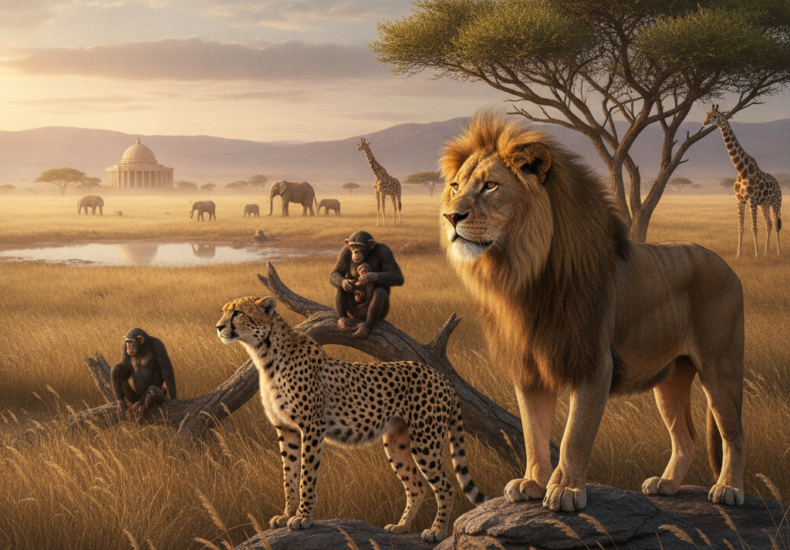
Lions and cheetahs and chimps, oh my: a spotlight on Africa’s diverse wildlife as reflected on by Sensei Michael Jinpa
Early autumn winds often stir the salt air here at Harborview Point. This brings a cool clarity to our sanctuary gardens as the tide rolls against the breakwater. Yesterday evening, the parish hall screen lit up with preview scenes from a new National Geographic documentary. Several retreatants gathered in quiet awe. We watched footage of hunting cheetahs, resting lion prides, and chimpanzee troops moving through canopy shadows. On the surface, the dramatic savannas and equatorial forests seem impossibly distant from our quiet Pacific harbor. However, contemplating wild lives collapses that distance. It reveals an immediate kinship with Africa’s diverse wildlife.
In Buddhist practice, we often speak of pratityasamutpada, or dependent co-arising. Nothing truly exists in isolation. Every breath a predator takes, tracking game across an arid plain, shares an unbroken rhythm. This rhythm sustains our oceans, our atmosphere, and even our own frail bodies. When we watch these extraordinary creatures, our instinctive fascination is not idle entertainment. Instead, it is the spontaneous awakening of recognition. We are looking at our broader family, knit together in the vast, delicate web of sentient life.
Reflecting on Africa’s Diverse Wildlife: Kinship and Impermanence
Years ago, I worked as a hospice chaplain. I often noticed how the dying shed their attachment to human artifice. In their final days, people rarely spoke of social rank, possessions, or abstract disputes. Instead, they asked to see sunlight filtering through leaves. They wanted to hear birdsong from an open window. Sometimes, they simply wanted to hold a family pet. Facing impermanence strips away the illusion of our separation from the natural world. Wild creatures live constantly in that naked reality. They remain unburdened by human vanity, entirely present in each passing moment.
Furthermore, viewing these wild habitats today carries an inescapable moral weight. Nature documentaries too often risk becoming moving museum exhibits. They celebrate beauty while quietly glossing over our role in its destruction. Human development fragments corridors and changes climates. Consequently, the survival of these beings becomes perilous. In Zen ethical training, the first precept calls us not simply to avoid killing. It demands that we actively protect and reverence life. Radical compassion demands more. We must not consume images of endangered vitality as passive consumers. Instead, their vulnerability should break our hearts open into responsibility.
A Vow of Stewardship for Every Creature
In our seaside enclave, artists and craftspeople constantly attempt to capture the changing light on water. They hope to preserve fleeting grace. We see a similar devotion in the patient craft of wildlife filmmakers. They wait weeks in dust and silence to bear witness. For example, they might film a mother cheetah nursing her cubs. That degree of attentive waiting is itself a contemplative discipline. It teaches us how to look at the world without immediately seeking to conquer, domesticate, or commodify it.
When the screen finally went dark, our sangha sat together in the zendo for evening meditation. In the silence, the distant foghorn echoed across the bay. It blended with the memory of nocturnal roars across a distant continent. Cultivating mindful presence means realizing that reverence cannot be selective. We cannot truly cherish peace in our own hearts while remaining indifferent. We must care for the fate of the great wildernesses that sustain our planet.
May the beauty captured in these moving frames stir us beyond momentary wonder. May it awaken a steady, practical care for every creature sharing this single, fragile earth. Ultimately, this appreciation must turn into a living vow of stewardship.
Leave a Reply