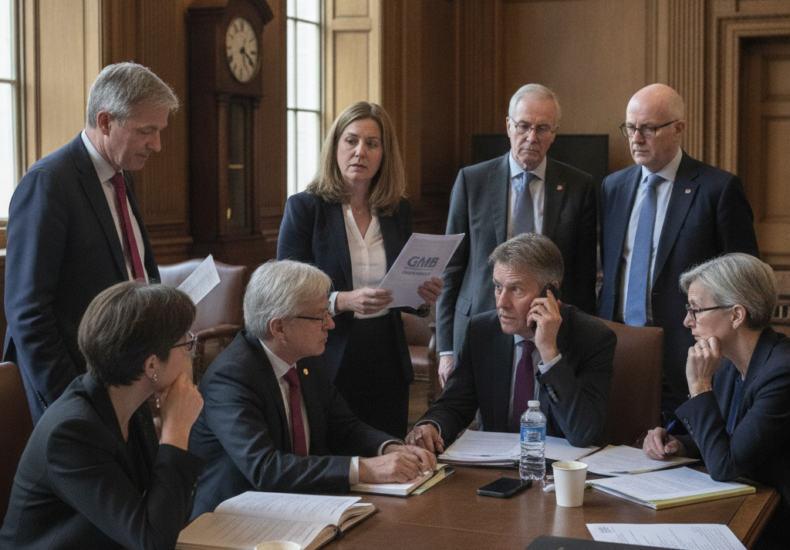
GMB warns Labour MPs that cap on political donations could endanger party funding as reflected on by Rabbi Aaron Klein
The recent news that the GMB union warns Labour MPs against a political donations cap raises significant questions for any community. Our Metropolitan Kehillah, situated amidst the pulsing currents of finance and culture, understands the complex interplay between resources and influence. This situation, where a major union cautions against limiting financial contributions to a political party, highlights a perennial tension. Specifically, it forces us to consider the ethical boundaries of funding political action and the very nature of communal giving.
Jewish tradition deeply values financial support for public good, known as tzedakah. We give to sustain our synagogues, schools, and charitable organizations. Furthermore, our sages teach that one must support the needs of the community. Yet, this giving comes with an inherent ethical framework. We ask: does the donation serve the collective welfare, or does it primarily secure undue influence for the donor? Therefore, the concern over a donations cap prompts us to reflect on the purity of intent behind such contributions. We must always strive for transparency and fairness in all our dealings, especially in matters affecting the broader society.
The Ethics of Political Donations Cap
The Torah commands us, “Justice, justice you shall pursue” (Deuteronomy 16:20). This double emphasis on justice mandates not only the outcome but also the process. Consequently, when large sums of money enter the political arena, we must scrutinize the potential for disproportionate power. A political donations cap aims to level the playing field. However, critics suggest it might inadvertently harm grassroots movements or established alliances that rely on larger, collective contributions. We must carefully balance the need for broad participation with the prevention of corruption. Indeed, the challenge lies in ensuring that all voices, not just the loudest or wealthiest, can shape the public discourse.
Our tradition recognizes the legitimate role of advocacy and the need for resources to effect change. We understand that organizations, like unions, represent the interests of their members. Therefore, they naturally seek to influence policy. However, the integrity of the democratic process remains paramount. We must safeguard against any system that allows financial might to overshadow moral right. This requires careful consideration of how such a cap impacts the ability of diverse groups to advocate for their causes. Ultimately, the goal is to foster a political landscape where merit and public good guide decisions, not merely the size of a contribution.
Maintaining Covenant in Public Life
The concept of brit, or covenant, underpins our entire faith. This covenant extends beyond the synagogue walls and into our engagement with the secular world. We have a responsibility to uphold ethical standards in all spheres, including politics and finance. Therefore, the debate around a political donations cap becomes a modern-day test of our commitment to communal integrity. We must ask: are we building systems that reflect our values of justice and equity? Furthermore, are we ensuring that those who govern truly serve the public, free from undue influence?
Navigating these complex issues requires wisdom and a commitment to justice. We seek to build a society where resources empower, rather than corrupt, the pursuit of the common good. Thus, as communities grapple with funding mechanisms, we encourage an approach rooted in ethical transparency and the pursuit of a truly just society. We pray for leaders who prioritize the welfare of all citizens, ensuring that financial contributions never compromise the sacred trust placed in them.
Read the original news coverage on The Guardian (World).

Leave a Reply