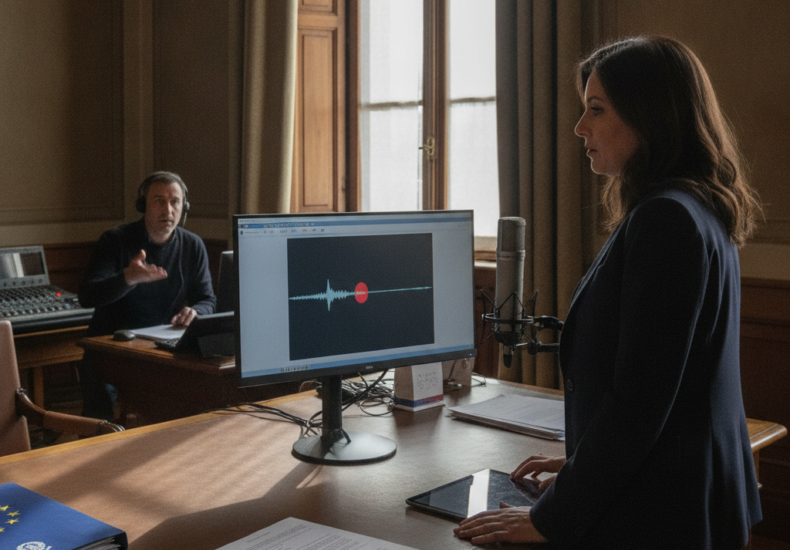
Italian PM files to trademark her voice against AI threats as reflected on by Venerable Geshe Lobsang Tenzin
In our institute’s debate courtyard, students spend years examining sound, designation, and identity. A spoken word arises from physical breath. It strikes the palate and vanishes instantly. It possesses no permanent core. Yet throughout human history, we have treated the human voice as an unmistakable seal of presence. When someone speaks, we assume a living mind stands behind the vibration. It bears intention, memory, and moral responsibility. The news that the Italian Prime Minister has filed to legally trademark her voice against artificial synthesis reveals this ancient assumption’s fragility.
From a legal and administrative perspective, her action is entirely understandable. Synthetic speech can convincingly replicate any person within seconds. Therefore, the danger of deception is immediate and severe. Deepfakes do not merely steal a person’s likeness. They steal their capacity to bear witness. In Buddhist epistemology, valid cognition relies heavily on reliable testimony. This is especially true in human affairs where we cannot perceive every truth directly. When the link between an authentic speaker and their spoken word is severed, society loses a primary instrument of shared truth.
The Irony of Trademarking a Voice
As a monk trained in analytical meditation, I also observe a profound irony. Someone attempts to trademark four seconds of acoustic resonance. In our philosophical texts, we study human suffering. It often begins with grasping at that which is inherently composite and fleeting. A voice is not an enduring object one can lock inside a vault. It is a dependent arising, born of lungs, vocal cords, air pressure, and the attentive ear of a listener. Attempting to own it through bureaucratic registration is a desperate secular remedy. This technological dilemma touches the very core of what constitutes an authentic person.
The deeper ethical challenge of generative intelligence lies in intentionality. A computer program does not possess consciousness. It lacks moral conscience or the capacity to experience karmic fruition. It combines data points, frequencies, and patterns. It does so without any understanding of compassion or harm. When bad actors weaponize these synthetic voices to fabricate falsehoods, the transgression is not merely a violation of intellectual property. It is an act of deliberate spiritual harm. It intentionally obscures the discerning wisdom of others and fosters paranoia across the community.
Cultivating Trust Beyond Legal Remedies
In our lectures on secular ethics, we frequently emphasize external laws. These laws are necessary. However, they can never fully heal an internal crisis of honesty. Trademark offices and courts may penalize infringers. This happens after a forgery has circulated. Yet they cannot restore the quiet confidence that once allowed neighbors and citizens to trust what they heard. When every recording must be viewed with suspicion, the collective mind grows fatigued, cynical, and guarded. This erosion of mutual trust is a subtle form of societal decay. It is far more dangerous than the technical apparatus producing the illusion.
True protection against deception requires mental cultivation alongside legal defense. In our tradition of mind training, or Lojong, we teach discernment. One must not be carried away by every appearance that meets the senses. We must train ourselves to listen with discerning patience. We must verify claims rather than reacting impulsively to sensational words. If technology makes sensory perception unreliable, our inner faculty of critical examination must become sharper. It must remain grounded in calm awareness rather than reactive fear. This approach complements efforts to trademark her voice or similar digital assets.
Ultimately, a human voice draws its true dignity not from its acoustic frequency. Instead, it comes from the virtue of the heart that guides it. An algorithm can copy the pitch, timbre, and rhythm of an Italian leader. It can copy any other human being. But it cannot synthesize genuine loving-kindness or the courageous commitment to speak the truth. While governments scramble to build fences around digital shadows, our primary duty remains cultivating speech. It must be truthful, beneficial, and rooted in goodwill. That moral authenticity is the one thing no machine can ever simulate.
Leave a Reply