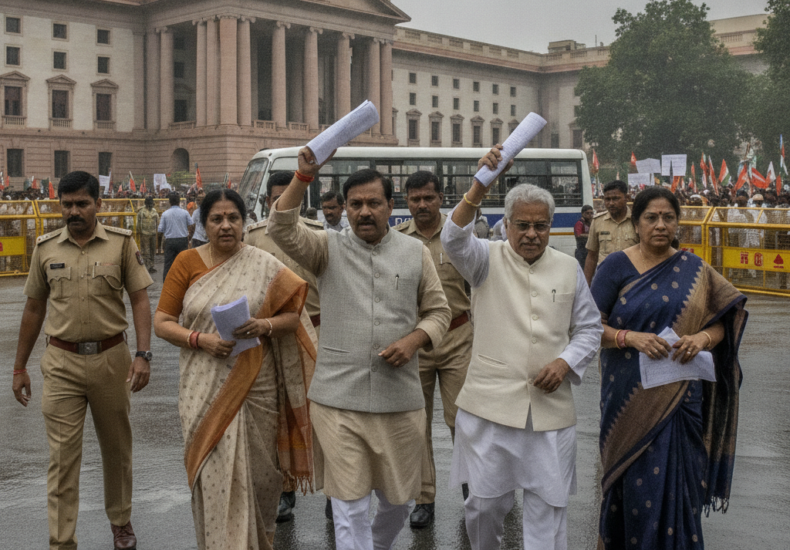
Indian opposition leaders detained during voter lists protest as reflected on by Swamini Ananda Saraswati
Here at the Ganga Mandir Sanctuary, the morning commences with the steady recitation of the Shanti Mantra. The river glides past the grey stones of the lower foothills. These waters do not compete with the banks, nor do the banks resist the current’s passage. However, down in the capital, news arrives. Opposition leaders were detained outside the Election Commission offices, their voices raised in protest over voter lists and civic transparency. In the capital, power measures itself by containment, numbers, and immediate control machinery.
From a classical Advaita Vedanta view, this struggle over governance reflects Maya’s ceaseless friction. Maya is the realm where names and forms constantly contest their boundaries. When society gathers to debate who is counted or erased from civic registries, it touches Dharma’s fragile social contract. A legitimate civic order cannot sustain itself merely through coercive force. Nor can it rely on administrative silencing. Dharma requires truthfulness, known as Satya, and equity. Indeed, it demands hearing every voice within the shared field of action.
Dharma, Detainment, and the Voter Lists Protest
Authorities often respond to political dissent with sudden detentions. The underlying motive almost always comprises fear disguised as strength. The ego, whether personal or institutional, seeks permanence. It attempts to barricade itself against criticism. Consequently, it forgets that authority is a temporary trust, not an inherent possession. The Mundaka Upanishad reminds us that truth alone triumphs, not falsehood. Suppressing grievances does not dissolve the underlying dispute. Instead, it merely drives anxiety deeper into the collective psyche, where it festers as resentment and distrust.
True governance begins with inner equilibrium. This mastery of the mind is known as Dama and Sama. Leaders who lack self-restraint inevitably wield outer power as a blunt weapon. When a governing body fears scrutiny over basic democratic procedures, such as the integrity of voter registers, it reveals internal disquiet. An institution rooted in genuine justice welcomes open daylight. It does not need barricades to validate its fairness, because clarity itself provides protection.
Righteous Action and Civic Well-being
For those who protest, the ethical obligation is equally demanding. In our sacred texts, righteous action must remain untainted by hatred. It must instead be guided by the discipline of Ahimsa. Resistance that mirrors the arrogance and hostility of its oppressor merely perpetuates the cycle of division. When representatives take to the streets, their purpose must remain anchored in service to the common well-being. It must not be driven by partisan malice. The moral strength of nonviolent witness lies in refusing to dehumanize the opponent. This holds true even while standing firm against administrative injustice.
As the sun rises higher over the forested ridges, the lessons from the forest hermitages remain unmistakable. A nation is not an abstraction of ledgers and security cordons. Rather, it is a tapestry of living beings bound together by mutual dignity. When any citizen or representative is disenfranchised or silenced without due hearing, the moral balance of the entire polity suffers. True security does not come from locking gates against dissenters. Instead, it comes from cultivating a civic culture where honesty is honored above power. Furthermore, every soul is granted its rightful place under the sun.

Leave a Reply