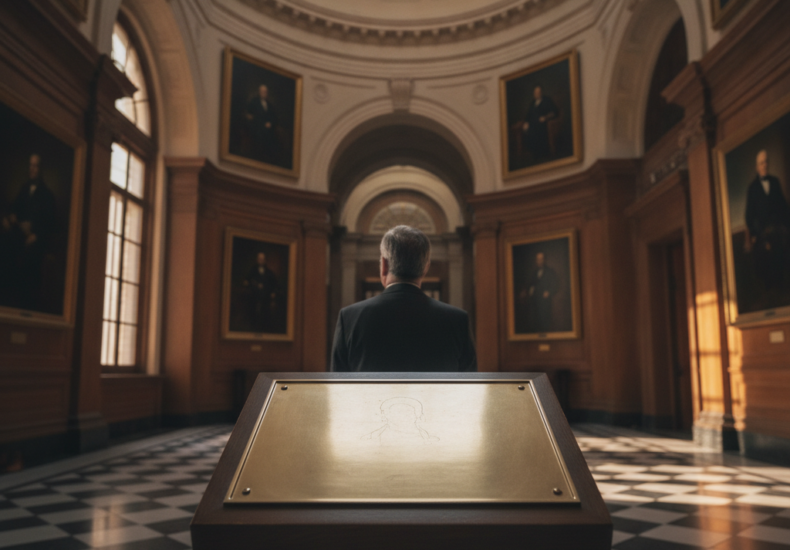
A history of presidents naming things after themselves (It’s short. They rarely do) as reflected on by Sister Maria Teresa Morales
Every afternoon at our hospitality shelter, our intake team sits across from men, women, and children. They have carried their entire lives across miles of desert. Before we offer clean socks or warm broth, we ask for their names. We write those names carefully in a spiral notebook. We honor each syllable with reverence. In the desert, a person’s name often remains their last possession. It is not an ornament of prestige. Instead, it asserts God-given dignity. No border barrier or bureaucrat can erase it. The impulse to brand public spaces, like naming public monuments, often reveals a different kind of hunger.
News reached our clinic kitchen about Donald Trump’s campaign. He actively seeks to place his personal brand on public monuments, like the Kennedy Center. Consequently, conversation among our volunteers grew quiet. Historical records remind us that sitting presidents almost always refrained from carving their own monikers onto public assets. This restraint was never a mere quirk of etiquette. Rather, it confessed an implicit stewardship. It acknowledged that public office is an act of temporary custody, not private ownership. The common heritage belongs to the people who build and sustain it.
Stewardship and Naming Public Monuments
From the vantage point of Christian ministry, the hunger to engrave one’s own name upon stone structures reveals profound spiritual confusion. Catholic social teaching states that the goods of the earth exist under a universal destination. Civic institutions safeguarding public life also share this purpose. They belong to all of God’s children, especially future generations. When a leader seeks to rebrand the common wealth with his personal seal, he replaces stewardship with vanity. He attempts to turn a civic commons into an altar consecrated to himself.
Scripture speaks candidly about this ancient impulse. In the Book of Genesis, builders on the plain of Shinar gathered bricks and bitumen. They had a singular ambition: “let us make a name for ourselves.” The Tower of Babel did not fall simply because it reached toward the clouds. It fell because it sought to substitute human self-aggrandizement for humble relationship with God and neighbor. Whenever power obsesses over stamping its imprint on the landscape, it usually signals an inner poverty. It reveals a quiet terror of being forgotten once earthly power fades.
True Authority on the Borderline
Here on the international borderline, true authority looks entirely different. It does not advertise itself on brass plaques or gilded archways. We see authority in the quiet endurance of a young mother. She wraps her infant in a donated blanket, shielding the child from the dry night chill. We also see it in local parish volunteers. They scrub clinic floors at dawn without seeking recognition or applause. Their names will never be chiseled onto civic auditoriums or federal edifices. Yet, their labors form the real masonry. This masonry keeps our fragile world from collapsing into callous indifference.
Jesus continually warned His disciples against the habits of rulers. They love the highest places, loud titles, and public salutations in the marketplaces. He taught that whoever wishes to be first must become the servant of all. True greatness, in the eyes of the Gospel, is not measured by how many walls bear our likeness. It is measured by how faithfully our hands wash the feet of the forgotten. A leader who understands his office does not need to brand the temple. He enters it with fear and trembling. He feels grateful merely to serve its courts for a brief season.
The names that endure through eternity are not those bolted to public buildings through political leverage. In the Gospel of Luke, Christ told His disciples not to rejoice over earthly influence. Instead, they should rejoice that their names are written in heaven. When earthly rulers finally relinquish their power, they stand before the Creator. No bronze letters or marble facades will accompany them. Only love, mercy, and quiet fidelity will speak on their behalf. These virtues will endure long after the monuments of pride turn back into dust.
Leave a Reply