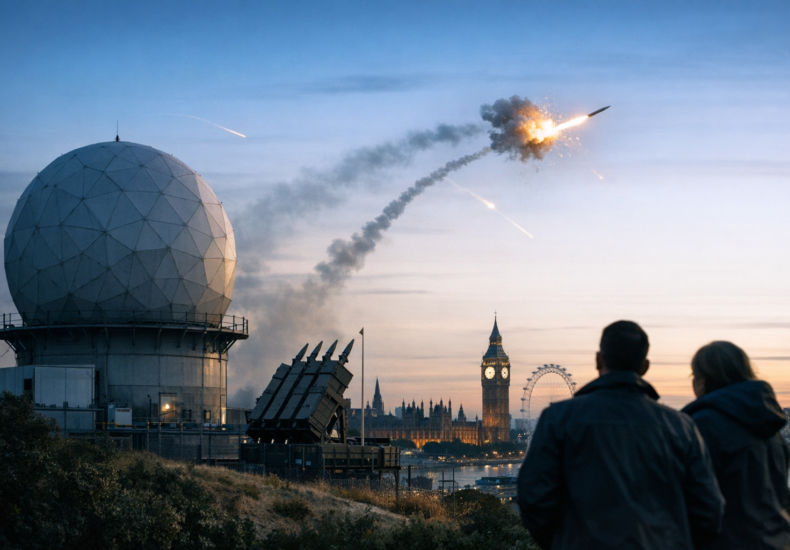
Conservatives propose £10bn ‘Britannia Shield’ inspired by Israel’s Iron Dome as reflected on by Rabbi Aaron Klein
Walking through our financial district’s concrete towers, then entering our shul’s quiet sanctuary, I notice modern security’s subtle architecture. Bollards, disguised as planters, line pedestrian plazas. Discreet surveillance monitors trading floors. Reinforced glass wraps art galleries. Humans always fortify their dwellings against vulnerability. Modern technology, however, shifts our defenses. They move from physical ramparts to invisible electronic canopies. The UK’s multi-billion-pound air defense proposal, called the Britannia Shield, directly models Israel’s Iron Dome. This reflects a profound shift in how Western nations perceive their own safety.
The Halakhic Imperative for Defense
For decades, geographic isolation and international alliances offered a comforting illusion. Western nations felt immune from direct physical assault. That era has evaporated. Modern ballistic technology and drone warfare flatten geography. They remind even secure maritime nations that vulnerability is no longer confined to distant borders. In Jewish halakhah, erecting a defense is not merely a prudential choice. It is an explicit religious obligation. The Torah mandates in Parashat Ki Teitzei, “When you build a new house, you shall make a parapet for your roof, so that you do not bring bloodguilt upon your house if someone falls from it.”
Maimonides and Talmudic sages expand this mitzvah of ma’akeh far beyond residential architecture. Indeed, any lethal hazard under one’s stewardship must be anticipated and neutralized. To leave a populace exposed, when protection means exist, is an abdication of moral responsibility. This holds true in Jewish jurisprudence. Yet, classical halakhah also forces us to confront severe ethical dilemmas regarding resource allocation. Ten billion pounds represents an immense portion of the public purse. Consequently, this sum diverts from healthcare, elder care, and poverty relief.
Beyond the Physical Shield
Our sages in the Talmudic tractate of Bava Batra debate taxing town residents for protective walls and city gates. They recognize that self-preservation must take precedence. Without life itself, no communal virtues can flourish. Physical security is the vessel that holds all other human pursuits. Still, spending treasure on shields always reminds us of the world’s tragic fractures. Furthermore, an air defense system represents a uniquely defensive military instrument. Unlike offensive munitions, designed to project force, systems like the Iron Dome exist solely to intercept destruction mid-air. They stop threats before reaching civilian doorsteps. Our synagogue’s boardrooms and legal offices constantly debate military ethics. Therefore, investing in pure defense offers clean moral clarity.
It values human preservation over destruction. It prioritizes the sanctity of life above projecting dominance. Still, our prophetic tradition cautions against placing ultimate, idolatrous trust in technological fortresses. The Book of Psalms reminds us, “unless the Lord watches over the city, the watchman stays awake in vain.” This is not a call to pacifism. Jewish law unequivocally demands rigorous human initiative and statecraft. Rather, it is a spiritual warning against hubris. Advanced radar arrays and kinetic interceptors can deflect incoming missiles. However, they cannot cure the deep political, social, and spiritual rot that breeds geopolitical conflict. This is the challenge for any Britannia Shield.
As sovereign nations around the globe prepare to shield their skies, they must remember a crucial point. Physical protection is only a society’s foundation, not its soul. A dome of interceptors can preserve our bodies and institutions from sudden violence. Yet, it remains our sacred civic duty to cultivate justice, equity, and moral courage. These virtues are truly worthy of being protected.

Leave a Reply