The dawn of the age of the exoskeleton as reflected on by Rev. Thomas Vance
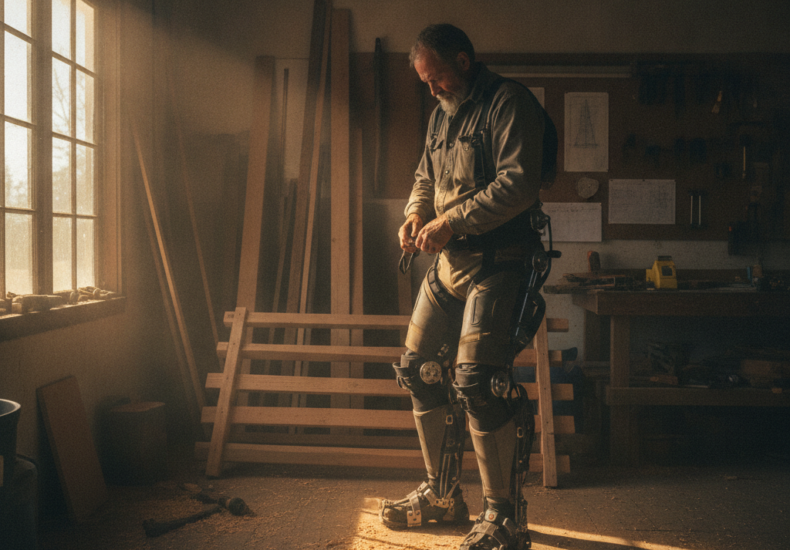
Yesterday afternoon, I visited Frank Higgins’ workshop near the edge of Pine Ridge. Frank spent forty years framing timber and hauling split-rail fencing across these hills. Now, severe degenerative arthritis has settled into his knees and hips. He carefully measures his steps across the gravel driveway. When news crossed my desk about modern medical prototypes becoming everyday tools for physical labor, Frank immediately came to mind. The promise of wearable frames that brace worn-out joints and lift burdens off human spines is not abstract. For us, it asks if broken bodies can find renewed dignity and relief from pain through **powered exoskeletons**.
Scripture treats the physical frame with deep reverence. Psalms remind us we are fearfully and wonderfully made. God formed us from dust and sustains us with His breath. Yet, that same dust carries inherent fragility. In rural communities like ours, physical labor is an honorable vocation. However, it often exacts a harsh, cumulative toll on the human body. When mechanical ingenuity offers a crutch or an external brace to alleviate agony, it joins a long, merciful tradition of healing. Restoring mobility to the lame and easing the heavy load of the weary always reflects the compassionate heart of the Gospel.
The Moral Compass of Powered Exoskeletons
Any pastor watching technological progress must ask what spirit directs the invention. If we adopt **powered exoskeletons** simply to squeeze extra grueling labor from an aging worker, we have not liberated the person. Instead, we have turned flesh into an interchangeable machine component. The moral value of any tool lies in whether it serves human flourishing. It must not subordinate human life to raw production quotas. We must remain vigilant. Mechanical assistance must never become an excuse to raise demands past human limits. We must avoid treating men and women as industrial beasts of burden reinforced with alloy and motors.
An inescapable question of neighborly equity also arises. Here in Pine Ridge, our agricultural co-ops and local food pantries operate because ordinary folks share their small surplus. Too often, groundbreaking advances in medicine and assistive engineering arrive with high price tags. These costs place them far out of reach for rural laborers, loggers, and modest family farmers who need them most. If restorative strength is sold only to corporate warehouses and wealthy enclaves, working people will limp into premature disability. Then, we fall short of biblical justice. A righteous society does not reserve physical relief for the privileged while the poor bear their afflictions alone.
On a deeper spiritual level, an external frame bracing the body offers a striking parable of grace. None of us walk through this life by the strength of our own sinews alone. From our first breath to our last, we depend on unseen support. This includes the sustaining grace of God, the quiet sacrifices of our families, and the dependable fellowship of our neighbors. When our inner strength falters, we require something sound and external to lean upon. A machine that steadies a trembling knee serves as a tangible reminder. Self-sufficiency is an illusion. Admitting our weakness is the very doorway through which help enters.
Our call in these hills is neither to worship new machinery nor to reject it out of stubborn fear. We are called to govern our inventions by love, humility, and moral responsibility. May we welcome every honest tool that lifts a heavy burden from a tired back. Meanwhile, let us hold fast to the sacred truth that a person’s worth is never measured by physical output. If we remember that technology must always answer to human mercy, even steel and silicon can become instruments of quiet, neighborly redemption.

Leave a Reply