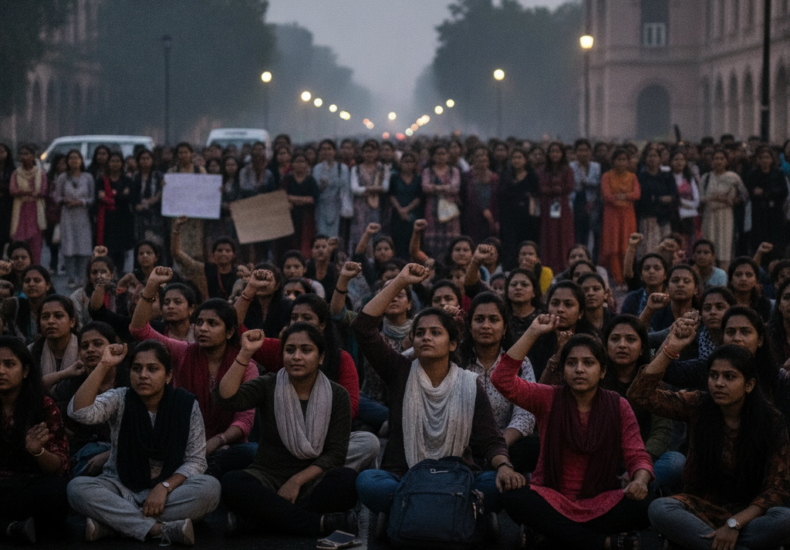
‘We want justice’: series of rapes trigger mass protests at Indian universities as reflected on by Imam Tariq Al-Mansoor
News reached our Al-Fajr office. University women in Delhi poured into the streets. They demanded safety. They also sought an end to recurring brutalities. This grief felt immediately familiar. Cedar Heights may be oceans away from Delhi, but our crowded avenues, dimly lit bus stops, and working-class corridors share the same anxiety. Every day, daughters, mothers, and sisters leave home. They seek education or honest labor. However, they carry a quiet, heavy vigilance. Public spaces have failed to protect their basic dignity. Indeed, these brave university women demand justice.
One student placard cut through the usual evasions. Girls do not need curfews, it declared; criminals need consequences. For generations, society defaulted to a cowardly habit. It confined the vulnerable instead of restraining the violent. Whenever predators roam unchecked, the standard civic response emerges. People tell women to dress differently, walk elsewhere, or stay indoors after sunset. This is not moral guidance. Conversely, it is an abdication of social duty. It punishes the victim. Simultaneously, it grants functional impunity to the transgressor.
Islamic Tradition: University Women Demand Justice, Not Confinement
The Islamic moral tradition establishes sanctuary in the commons. Justice begins here. Prophet Muhammad, peace be upon him, envisioned profound safety. An unaccompanied traveler could journey across vast terrains. She would fear none but God and the wolf for her flock. This prophetic horizon was not achieved by locking women away. Instead, it was built by creating an uncompromising ethical culture. It also established an enforceable legal standard. Men must govern their desires. Civil institutions must guard the vulnerable. Consequently, the public square remains inviolable for everyone.
The Qur’an commands modesty for women. However, it first addresses men. It gives an unyielding spiritual mandate: lower your gaze and guard your modesty. In our tradition, modesty extends beyond attire. It is an active spiritual discipline. It forbids predatory behavior, entitlement, and dehumanization. Transforming another human into an object of conquest or casual violence is profound spiritual corruption. When men treat public avenues as arenas of entitlement, they violate a divine trust. This trust is placed upon their hands, eyes, and power.
Here in Cedar Heights, young people face chronic economic instability. Moral moorings are shifting. We see what happens when communal accountability erodes. In our youth halaqas and interfaith coalitions, we constantly remind young men of true strength. It lies in chivalry, protective honor, and radical self-restraint. A man who uses intimidation or force against a woman demonstrates a hollow, bankrupt spirit. We must teach our sons that every woman on the street is their sister in humanity. She is entitled to absolute safety. Otherwise, we cultivate the ground for social rot.
The women demonstrating in Delhi are not asking for hollow platitudes. They do not want another commission of inquiry that yields no tangible reform. They demand a fundamental human entitlement. God has already ordained it: freedom to pursue life, knowledge, and vocation without terror. A society that forces its women to live under constant fear of assault has failed a primary civic covenant. Such a society cannot claim to be civilized. This holds true regardless of its technological advance or commercial wealth. Therefore, our prayers are with the victims and their families. They are also with all those risking intimidation to demand upright governance. Prayers must accompany civic courage. We must hold our law enforcement, courts, and cultural institutions strictly accountable. They must enforce justice without favoritism or delay. True civic peace will only arrive when our streets, whether in Delhi or Cedar Heights, are safe enough. No daughter should ever calculate the cost of walking freely under God’s sky.

Leave a Reply