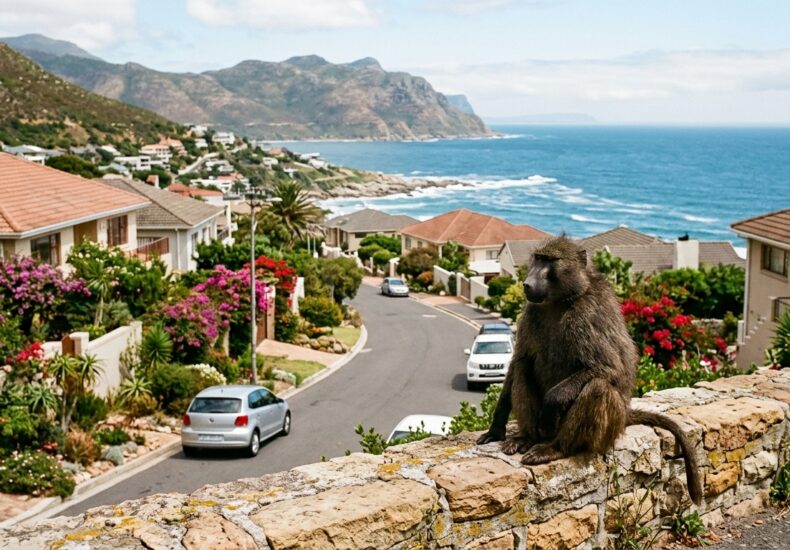
‘It’s hard to sell a house when it’s covered in baboon faeces’: Cape Town divided over plan to remove its monkeys as reflected on by Imam Tariq Al-Mansoor
After our dawn prayer at Al-Fajr Islamic Center, a few elders gathered. We discussed the weekly clean-up along the alley behind the market. In an overcrowded urban quarter like Cedar Heights, order and chaos exist on a razor-thin boundary. Waste overflows or common spaces suffer neglect. This pressure bears down hardest on ordinary working families. They lack the private resources to wall themselves off. I read about Cape Town’s standoff in this context of daily urban friction. The city faces a significant Cape Town baboon conflict. Baboon troops invade kitchens and storefronts, dividing neighborhoods. Some residents desperately seek relief; others defend an unbending ideal of untouched wildlife.
The Burden of Unmanaged Wildlife
At first glance, a primate dispute thousands of miles away might seem alien. Our concrete-heavy district, however, shares the underlying tension. The debate pits a distant, abstract conservationism against immediate, tangible burdens. These burdens disrupt daily domestic life. An estate agent complains that a home covered in animal waste cannot be sold. Affluent onlookers might scoff at commercial self-interest. But for an ordinary family, a home is more than an asset. It is a sanctuary of dignity, safety, and modest security. When that sanctuary suffers repeated breaches, abstract moralizing from comfortable suburbs offers little solace.
The Islamic tradition defines our human relationship to the natural world. It uses the concept of khilafah, or moral stewardship. We are not ruthless tyrants. We cannot slaughter other creatures for convenience. Nor are we helpless bystanders forbidden from maintaining civic order. Creation exists in an intentional balance. The Quran names this balance the mizan. Human settlements expand carelessly into natural habitats. This breaks the balance. The baboons did not choose to wander through residential pantries with malice. They followed hunger and broken boundaries. Human development encroached upon their hillsides, drawing them into human territory. We failed to establish durable limits.
Stewardship and Ethical Compromise
This dynamic reveals our urban planning’s moral failure. Decades ago, Cape Town halted culls under public pressure. However, it failed to enact rigorous waste infrastructure, secure boundaries, and long-term wildlife management. These measures would prevent inevitable clashes. Mercy without foresight and discipline is not true compassion. It is merely sentimentality. Allowing wild populations to multiply into domestic corridors until desperation turns neighbors against animals represents a governance failure. Prophetic teaching emphasizes active, orderly, and preventive mercy. It protects the vulnerable human household. It also ensures animals are spared prolonged misery, harassment, and retaliatory violence.
The city decided to relocate and sterilize the conflicting troops. They will live within a managed sanctuary. This represents a difficult, imperfect, but necessary exercise in ethical compromise. In our civic coalitions in Cedar Heights, we frequently face agonizing trade-offs. You cannot always achieve an unblemished ideal when competing interests create friction. Sometimes justice demands relocating a harm. This protects the sanctity of homes. It also prevents desperate citizens from resorting to poison or pellet guns. A planned sanctuary restricts the animals’ ancestral roaming. Nevertheless, it honors both the creature’s life and the human community’s need for safety in this Cape Town baboon conflict.
Our cities cannot survive if we treat moral stewardship as an all-or-nothing contest. We must avoid choosing between absolute wildness and total eradication. True civic virtue requires humility. We must acknowledge when past missteps have created untenable friction. As stewards under God, we have a duty. We must repair the breach with patient, practical measures. These safeguard human dignity. They also prevent our hearts from hardening against the beasts who share the earth with us. We must build secure neighborhoods. Public squares must remain clean. We must bear our shared responsibilities to all creation with serious, disciplined care.
Leave a Reply