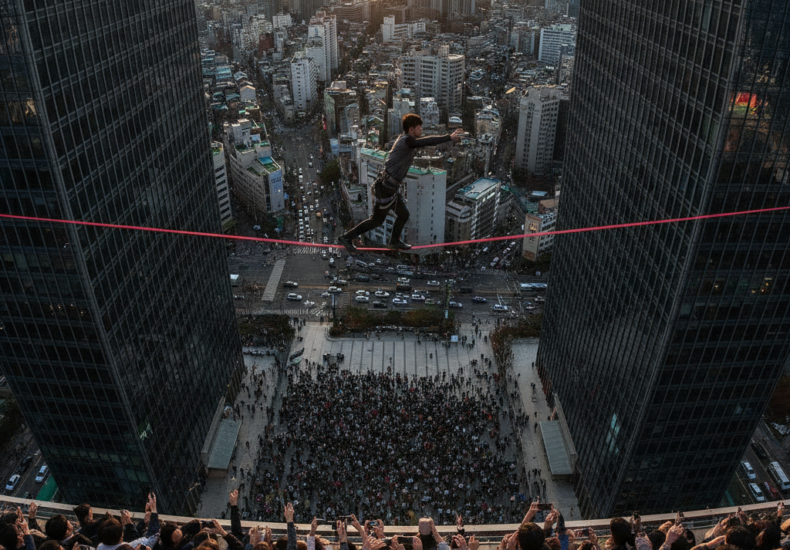
Daredevil Jaan Roose completes slackline walk high above central Seoul as reflected on by Rabbi Miriam Levin
An Estonian athlete stepped onto a ribbon of webbing high above central Seoul. Crowds craned their necks below as he completed his incredible slackline walk Seoul. My thoughts immediately turned to our suburban streets in Highland Woods. Our congregation members do not typically gaze up at high-wire crossings. Instead, they commute on the expressway. They negotiate client contracts. They schedule doctor appointments for aging parents. Or they rush between soccer practices. Yet, almost every soul in my study this month has spoken about keeping their footing. They feel life’s precariousness daily.
Walking Life’s Narrow Bridges
The image of walking across an immense void on a strip no wider than a belt resonates powerfully. It connects deeply with Jewish spiritual memory. Rebbe Nachman of Breslov offered a famous adage in modern Jewish thought. He taught that the entire world is a very narrow bridge. The essential thing, he said, is not to be overcome by fear. Nachman did not celebrate reckless bravado. He described the baseline reality of human life. Between birth and death, or between health and sudden vulnerability, our days unfold across narrow crossings. The margins for error often feel unimaginably thin.
However, an essential ethical difference exists. A daredevil chooses a high line for spectacle. Ordinary men and women must navigate life’s daily tightropes. Our tradition holds life itself as sacred. It is an uncompromisable gift, bound up in covenantal responsibility. Therefore, rabbinic ethics cautions against testing mortal frailty. This applies when someone risks their life purely for thrill. Yet, the lunchtime office workers in Seoul recognized something primal. They saw human vulnerability made visible against modern commerce’s glass and steel. This primal recognition likely arrested their attention, not just adrenaline.
Community: Our Stabilizing Hand
In our quiet suburb, people walk invisible high wires. These are rarely celebrated with cameras. They are the tensions of caring for a spouse with dementia. They are the agonizing balance of parenting an adolescent with clinical depression. Or they are the fragile effort to sustain a marriage under prolonged financial strain. These are the narrow bridges where a single misstep feels catastrophic. Unlike an urban spectacle, these daily balances are walked without safety nets. There are no cheering crowds. Often, people walk these paths in profound isolation.
Our Talmudic sages understood this deeply. Human beings were never meant to traverse narrow bridges entirely alone. When the community gathers, its first obligation is clear. It must establish the ground beneath one another’s feet. In tractate Berakhot, the sages teach a powerful lesson. A prisoner cannot liberate himself from his own cell. He needs someone from the outside to take him by the hand. What keeps any of us upright during times of vertigo is rarely solitary balance. It is the presence of community members who notice our sway. They extend a stabilizing hand before we fall.
I reflect on that solitary figure balanced between towers in Seoul. I consider what it means to build a community. This community must bear life’s gravity. We engage in sacred work when we advocate for accessible mental health services. We sit in silence with a grieving family. Furthermore, we gather across faith lines to bridge civic fractures. We are widening the path. We cannot eliminate mortality’s inherent hazards. Nor can we remove every abyss that opens across a lifetime. Ultimately, the call of faith is neither to court unnecessary danger nor to shrink back in paralyzing dread. Rather, it is to take the next deliberate step in trust. We remember that our journey’s dignity is measured by the covenants that hold us steady. Let us look up from our busy routines. Let it not be merely to marvel at those who flirt with danger. Instead, let us see our neighbors. They are walking through trembling moments right now. They wait for us to meet them on the bridge.
Leave a Reply