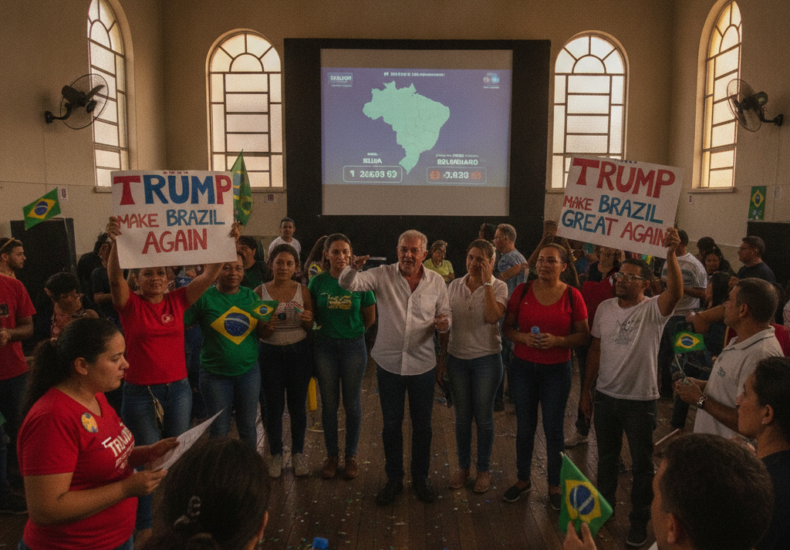
Brazil’s neck-and-neck election offers test for growing pro-Trump Latin American bloc as reflected on by Rabbi Miriam Levin
In our Highland Woods synagogue, civic life often feels insulated by quiet cul-de-sacs. However, during our weekly Talmud study, conversations inevitably wander toward global democratic tremors. We watch reports from Brazil, where an election balances on a knife edge amidst fierce polarization. This anxiety feels intimately familiar. Brazil’s election test asks a crucial question: Will collective destiny be forged through shared covenant or through political dominance?
Power, Leadership, and Brazil’s Election Test
Our tradition takes an exceptionally sober view of power and charismatic strongmen. The Book of Samuel offers a stern warning. Israelites clamored for a king, wanting to fight battles and unite like other nations. The prophet reminded them: power concentrated in a single sovereign exacts a heavy toll. It impacts freedom, family, and humility. Judaism has never placed its ultimate faith in political saviors or ideological blocs. We understand that human leaders are fundamentally flawed. They remain bound by the same moral commandments and ethical obligations as the humblest citizens.
The Mishnah asks in Pirkei Avot, “Who is strong? One who subdues their own inclinations.” This classical definition stands in stark opposition to contemporary political rhetoric. Modern politics often defines strength as winning at all costs or subjugating opponents. It boasts of unbroken electoral streaks. When political coalitions measure their worth primarily by tallying victories, they lose sight of deeper governance. Legitimate strength does not lie in dominating the public square. It lies in self-restraint, justice, and the relentless pursuit of social peace.
Rejecting Baseless Hatred and Seeking Covenant
Something deeply concerning arises when political factions weaponize religious devotion. They invoke sacred symbols and patron saints to heighten tribal rivalries. In our work with suburban multi-faith councils, we constantly strive to protect the sacred. We prevent its degradation into a campaign prop. The third commandment instructs us not to take God’s name in vain. Many commentators explain this prohibition. It includes enlisting the Divine to sanctify partisan hatreds. It also forbids claiming exclusive heavenly backing for a political agenda. When faith is reduced to a cudgel, civil discourse and religious integrity suffer catastrophic harm.
A neck-and-neck election exposes a fractured body politic. Nearly half the population fears the triumph of the other side. The Talmud recounts that the Second Temple was destroyed not by external armies. Instead, sinat chinam, baseless hatred among neighbors, caused its downfall. They could no longer bear each other’s differences. When political life turns into existential warfare, the civic fabric disintegrates. Healing such a breach requires an intentional, painstaking commitment to the idea of covenant. Unlike a fragile contract built merely on shared self-interest, a covenant calls a people to mutual responsibility. This holds true even when they profoundly disagree.
The work of Tikkun Olam, repairing our cracked world, rarely happens through sweeping political triumphs. It does not come from triumphant speeches in international capitals. It builds steadily from the ground up, in local communities. Here, people learn to listen across difference. They protect vulnerable minorities and honor the dignity of the democratic process. As we watch the citizens of Brazil cast their ballots, our prayer cannot simply be for one faction to crush another. Our prayer must be for a renewal of humble leadership. We pray for the courage to reject baseless enmity. Finally, we pray for the wisdom to build a society where truth, justice, and compassion outlast the fleeting arrogance of power.
Leave a Reply