Brazil goes to polls in decisive election for future of Latin America as reflected on by Rabbi Miriam Levin
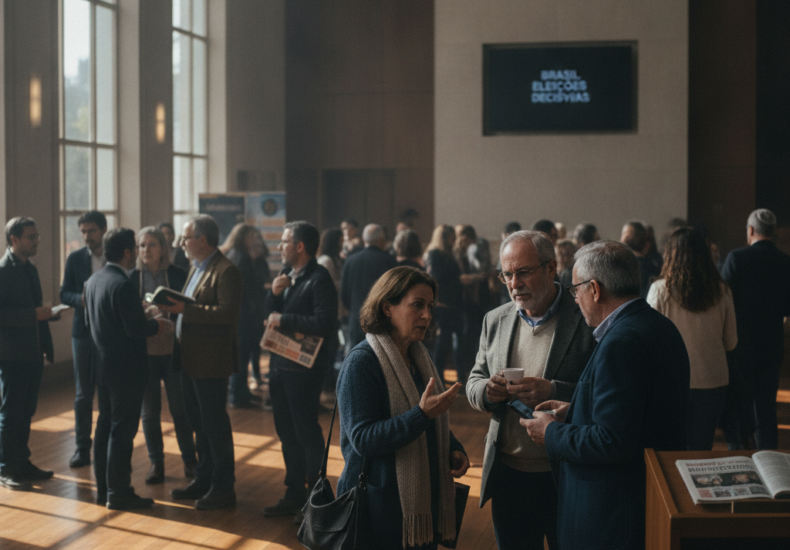
This morning, congregants gathered in the foyer of Kol Shalom before our study minyan. The conversation quickly shifted from local suburban concerns to international news. Several families in our Highland Woods community have relatives in São Paulo and Rio de Janeiro. Reports of millions of Brazilians lining up at polling precincts brought palpable tension into our sanctuary. The contest between Luiz Inácio Lula da Silva and Flávio Bolsonaro is more than an electoral referendum. It presents a stark confrontation between two fundamentally divergent visions of civic life, memory, and governance. This Brazil decisive election holds significant weight.
Our Jewish tradition, found in Pirkei Avot, the Ethics of the Fathers, offers Rabbi Shimon’s warning: be mindful of the government. Authorities, he teaches, do not draw a person near except for their own purpose. Yet, our sages also commanded us to pray for the governing order’s welfare. Without civic stability, people would, they knew, swallow one another alive. The ballot box remains an imperfect instrument. However, it is one of humanity’s few mechanisms. It adjudicates collective life through spoken consent, not intimidation, force, or brute decree.
Covenant and Leadership in Brazil’s Election
Watching this election unfold under the shadow of a convicted predecessor highlights the fragility of covenant. A convicted predecessor serves decades for an attempted coup. In the Torah, a covenant is not a mere transactional contract. It signifies a shared moral commitment. This commitment aims to preserve life, maintain truth in the public square, and protect the vulnerable. It shields them from the arbitrary will of the strong. When leaders treat democratic processes as disposable, they tear at basic social fabric. They regard the peaceful transfer of authority as optional. Consequently, neighbors begin seeing one another as mortal enemies.
The polarization gripping Brazil feels deeply familiar to anyone building community here at home. In our work with suburban civic groups and multi-faith councils, we repeatedly encounter trust’s quiet erosion. We see how legitimate political difference easily morphs into totalizing contempt. The opponent is no longer a fellow citizen with opposing priorities. Instead, they become an existential threat to crush. Such ideological absolutism suffocates genuine dialogue. It leaves little room for the patience required to sustain a healthy commonwealth. The stakes are high in this Brazil decisive election.
Striving for Justice: Tikkun Olam
Our tradition places immense weight on leadership ethics. It insists that true authority is measured by how a society treats the orphan, the widow, the impoverished, and the stranger within its gates. Latin America faces urgent structural challenges. These include deep economic disparity, regional instability, and the stewardship of the Amazon basin. The Amazon holds critical importance for our shared global ecology. The leaders emerging from this vote will bear a grave responsibility. They serve not only their partisan base. They also serve millions of marginalized souls whose daily survival depends on honest, functional governance.
Tikkun Olam, the repair of our broken world, rarely comes through sudden political conquest. More often, it is the quiet, daily labor of restoring integrity to public institutions. It involves telling the truth in public forums. It means respecting the boundaries that prevent power from becoming tyrannical. As ballots in Brazil are tabulated and the democratic process takes its course, our prayer is for peace in the streets. We pray for restraint among the powerful. We also pray for the enduring resilience of a people striving to build a just and stable future together.

Leave a Reply