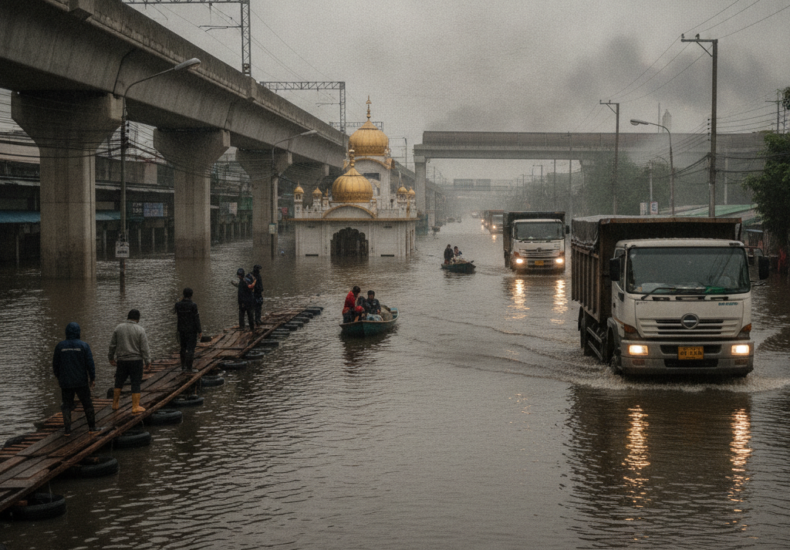
Bangkok at breaking point as floods turn streets into stagnant lakes as reflected on by Giani Harpreet Singh
At our Gurdwara, situated beside the regional freight corridor, we measure time differently. We track it by diesel rigs, shift horns, and changing weather patterns. Our community kitchen operates twenty-four hours daily, providing hot dhal and roti. We serve exhausted long-haul drivers, warehouse workers, and anyone facing sudden adversity. News arrived that Bangkok had reached its breaking point, with forty lives lost and fifty districts swallowed by stagnant floodwaters. The dispatch screens in our bay did not feel distant. They mirrored a reality every logistics operator and field volunteer knows intimately: human infrastructure, no matter how grand, always stands on borrowed ground. The **Bangkok flood crisis** reveals this truth.
The Guru Granth Sahib honors water as the first father. It is the primordial element sustaining all living things. “Pavan Guru, Pani Pita, Mata Dharat Mahat” reminds us, air is the teacher, water the father, and the vast earth the great mother. However, humanity often alters the earth with unyielding concrete. We pave over natural wetlands and treat creation as mere acreage for profit. Consequently, water transforms from a nurturer into an unrelenting judge. The deluge submerging Bangkok is not a freak mystery; it is a visible friction. It highlights the clash between our engineered pride and the timeless balance of divine order, Hukam.
Responding to the Bangkok Flood Crisis
Here at the crossroads, where freight lines intersect, we understand a painful truth. When supply chains collapse, boardroom executives rarely bear the heaviest cost. Reports describe affluent high-rises isolated like islands. Meanwhile, informal settlements, street vendors, and transport laborers drown in contaminated, stagnant sludge. This represents the starkest moral failure of modern urban development. Vulnerable people consistently face relegation to the low ground, both socially and physically. Sikhi teaches the radical equality of all human beings. It insists a society’s ethical worth measures strictly by how it shelters the humblest among us.
When waters stagnate and streets become impassable, despair easily takes hold. Yet, our tradition actively refuses passive sorrow. Sikhi demands Chardi Kala. This spiritual discipline means rising above adversity through active, unshakeable courage. True Chardi Kala does not mean pretending suffering does not exist. Instead, it involves looking directly into the floodwaters. We acknowledge the grief of forty families who lost loved ones. Then, we immediately light the kitchen fires. Hope is not an abstract meditation. It is an operational necessity, forged by rolling up our sleeves and stepping into the mud to pull a neighbor free.
A Call for Humility and Seva
Disaster relief fundamentally expresses Seva. This means selfless service rendered without regard for creed, race, or status. Long before government boats or international aid convoys organize paperwork, ordinary human solidarity must take command. In our hub, whenever winter storms paralyze the interstate, the Sangat packs insulated crates of rations, matches, and clean water. We load them into whatever flatbed trucks can still navigate the margins. In Bangkok, humanity’s true soul becomes visible. We see it not in the stagnant waters, but in those using flat-bottomed fishing boats, plastic tubs, and bare arms to carry elders and children to dry ground.
The calamity across south-east Asia provides an urgent warning to every city and trade corridor on earth. We cannot continue treating climate disruption as a distant financial variable on a corporate ledger. The Guru calls us to live in deep reverence with creation. We must recognize the divine presence pulsing through every riverbank, field, and storm cloud. Stewardship of the earth is an inescapable spiritual duty, not a discretionary civic hobby. If we build cities that refuse to yield space for water to breathe and flow, we ensure our own displacement.
As the night shift changes and rain beats down on our Gurdwara’s metal roofs, our prayers turn toward the people of Thailand. We pray for comfort for those mourning the dead. We pray for endurance among the rescue crews, and for clear heads among the planners who must rebuild. Above all, we pray for the awakening of human conscience. May we learn humility before the natural elements. Let us tear down the barriers of selfish indifference. May we transform our shared communities into sanctuaries where no one is abandoned when the waters rise.
Leave a Reply