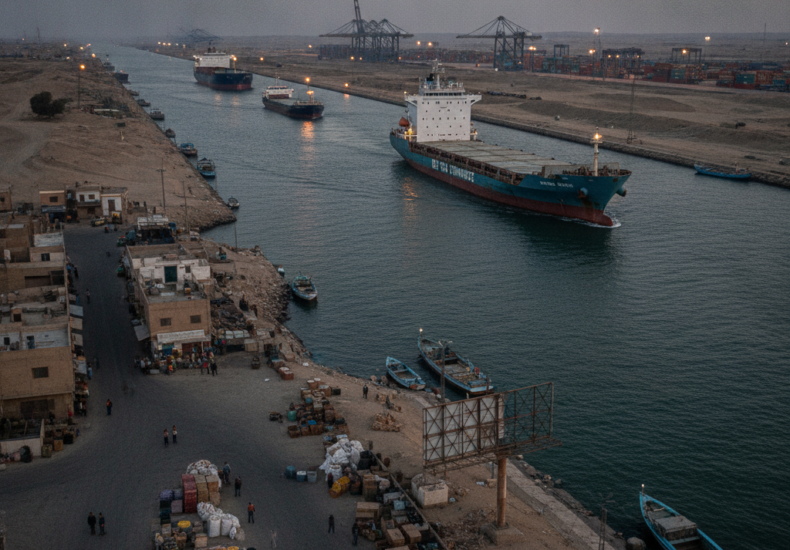
How did Egypt’s and Israel’s economies do in a year of Houthi attacks? as reflected on by Rabbi Aaron Klein
The recent Al Jazeera report highlights a concerning reality. Houthi attacks significantly slowed Suez Canal traffic. This disruption directly impacts the economies of both Egypt and Israel, consequently raising global goods costs. As a community leader in a bustling financial and cultural center, I observe these intricate connections daily. We see how geopolitical tensions reverberate through the markets and into our homes. Therefore, we must consider the ethical and spiritual implications of such events.
Our tradition teaches us about interconnectedness, a concept deeply relevant here. The Torah frequently describes how one nation’s actions can affect others. Furthermore, the Mishna in Pirkei Avot emphasizes, “The world stands on three things: on Torah, on Avodah (service to God), and on Gemilut Chasadim (acts of loving-kindness).” When trade routes suffer, the economic stability of nations weakens. This instability then threatens the very framework for peace and cooperation. Ultimately, it challenges our capacity for acts of loving-kindness on a global scale.
The Covenant of Shared Prosperity
The economic challenges stemming from reduced Suez Canal traffic demand a re-evaluation of our shared responsibilities. We learn from Parashat Mishpatim about the sanctity of fair dealings and the protection of livelihoods. When global commerce faces disruption, it is not merely a financial problem. Rather, it becomes a moral test for humanity. We must ask ourselves: how do we uphold a covenant of shared prosperity in an increasingly volatile world? Leaders must safeguard the pathways of commerce, ensuring that goods and services flow freely and fairly. This commitment benefits everyone, not just a select few.
In addition, the principle of pikuach nefesh, saving a life, extends beyond individual acts. It encompasses ensuring the foundational stability that allows societies to thrive. When the cost of basic necessities rises due to disrupted supply chains, human well-being suffers. We therefore bear a collective obligation to seek diplomatic solutions and protect vital global arteries. This effort requires wisdom, courage, and a profound commitment to justice. We must work towards a world where economic stability fosters peace, rather than becoming a casualty of conflict.
Navigating Global Crossroads
Our ancient texts also speak to the challenges of navigating complex international relations. Joseph’s story in Egypt, for instance, illustrates the delicate balance of power, diplomacy, and resource management. Today, the modern State of Israel, situated at a global crossroads, faces these same ancient dilemmas in new forms. The economic pressures on Israel and Egypt due to the Suez Canal traffic slowdown underscore this reality. Both nations possess rich histories and vital roles in regional stability. Their economic health directly impacts the wider Middle East and beyond.
Ultimately, Judaism calls us to pursue justice and peace. This pursuit involves understanding the intricate web of global economics and geopolitics. We must advocate for policies that prioritize human welfare and global stability. We must also recognize that true security comes through cooperation and mutual respect, not through isolated prosperity. Consequently, we pray for wisdom for leaders and for a swift resolution to conflicts that threaten our shared world. May we all strive to build a world founded on the principles of righteousness and compassion.
Read the original news coverage on Al Jazeera (World).
Leave a Reply