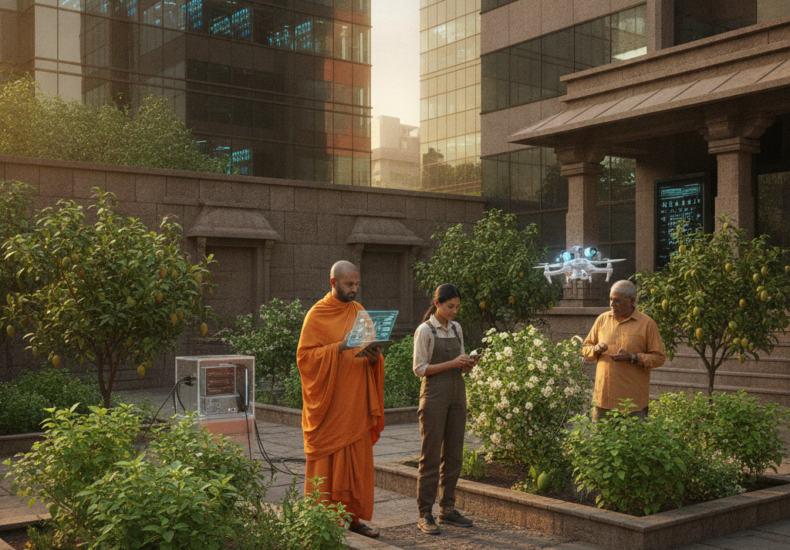
The AI telling farmers when to harvest as reflected on by Pandit Rajesh Sharma
In our temple courtyard, nestled among the glass office parks and humming server farms of our suburban corridor, we cultivate a small sacred garden. Tulsi, jasmine, and fruit-bearing pomegranate trees thrive here. Each morning, after offering the arati lamps, I walk among these plants. Determining a fruit’s ripeness for the altar has never been a matter of calculation alone. This act involves communion. I touch the skin, note the subtle change in scent, and understand how recent autumn rains have softened the soil. Therefore, when I read about algorithms designed to instruct farmers on the exact hour to harvest their orchards, I recognize both brilliant ingenuity and a quiet spiritual hazard. This AI harvest technology presents a unique challenge for our community.
The Vedic tradition views agriculture as more than an extractive industry. It is an ongoing yajna. This sacred sacrifice involves a cooperative exchange between human beings, the earth, and cosmic forces. The Bhoomi Sukta of the Atharva Veda reminds us the earth is our mother; we are her children. Consequently, a farmer walks the rows of an orchard, engaging hands and senses in an intimate dialogue with Prakriti, the living material world. That discernment is not arbitrary instinct. Rather, it is intuition cultivated through decades of humble observation, patience, and inherited memory. It reflects an embodied harmony between observer and observed.
Balancing Innovation and Intuition with AI Harvest Technology
Many congregants who come to our mandir on weekends are the very software architects building these predictive models. During our conversations, they often speak of optimization, yield maximization, and reducing human margin of error. Our world now faces supply chain disruptions, changing weather patterns, and the urgent need to feed growing populations. Therefore, such technological instruments possess undeniable merit. Dharma encourages practical competence and the alleviation of scarcity. To despise a tool that prevents food spoilage or spares a family farm from ruin would be foolish. Indeed, technology can serve as a potent instrument of seva, helping us steward resources with greater care.
However, we must examine what becomes displaced when delegation becomes surrender. Vedanta philosophy understands knowledge on multiple planes. Quantitative data exists, but so does Viveka. This discerning wisdom arises from deep, conscious presence. When an algorithm determines the moment of harvest, the human being risks becoming merely a mechanical executor of a digital command. The farmer’s senses, once finely tuned instruments of perception, begin to atrophy. We distance ourselves further from the soil. We view the orchard not as a living ecosystem of divine manifestation, but as a grid of data points waiting to be monetized. This applies to AI harvest technology and other digital tools.
Nourishing Our Inner Self in the Digital Age
This dynamic mirrors the spiritual challenge families face daily in our Silicon Hills neighborhood. Surrounded by smart devices, we gradually unlearn the ability to listen to our inner antahkarana, the mind and conscience. These devices monitor sleep cycles, dictate workout regimens, and automate daily choices. We become strangers to our own physical rhythms and moral instincts. If a farmer ceases to trust their fingers and eyes to know when an apple is sweet, how long before we forfeit our ability to sense when a child is troubled? How long before our own spirit is parched for stillness? Intuition is a muscle of consciousness. It weakens whenever we outsource it entirely to machines.
The Bhagavad Gita’s teaching of Karma yoga calls us to perform our work with skill, dedication, and detached mindfulness. We must do this without losing our grounding in the Self. A machine can analyze light reflection and sugar levels. However, it cannot cultivate reverence. It cannot feel gratitude toward the soil, the sun, or the rains. If agricultural algorithms are to be used, let them serve as secondary advisors rather than sovereign masters. Let the farmer consult the data. Ultimately, let the final touch remain human, grounded in an unbroken relationship with the tree. True stewardship requires that we keep our senses alive and our hearts receptive to creation’s sacred cadence. As digital acceleration reshapes every ancient vocation, our prayer must be for balance. We may welcome tools that support our labor, provided they do not sever the tender thread of awareness that connects human consciousness to the living earth.
Leave a Reply