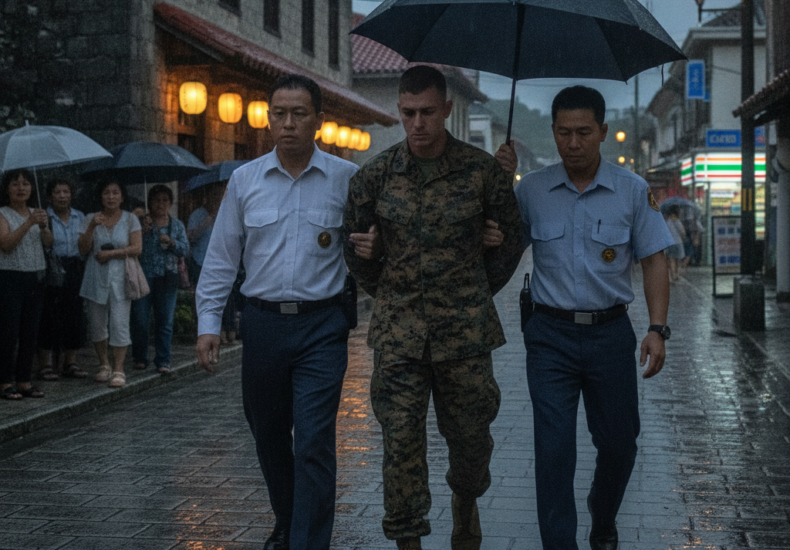
U.S. Marine arrested for alleged murder of a woman in Okinawa, Japan as reflected on by Imam Tariq Al-Mansoor
When news reached our study circle at the Al-Fajr Islamic Center, a familiar heaviness settled across the room. We learned of the tragic Okinawa murder, a violent death of a woman there. We gather in Cedar Heights, an urban corridor crowded with laundromats, auto repair bays, and walk-up apartments. Working families here struggle daily to secure basic safety. While Okinawa lies on the opposite side of the globe, the pattern of vulnerability feels intimately familiar. Anyone living in the shadow of concentrated power understands this feeling. Someone allegedly extinguished a life in a private home, deployed under the banner of sovereign protection.
Justice in the Islamic Tradition
The Islamic ethical tradition teaches that justice is not an abstract slogan. It is not a legal technicality reserved for diplomatic press releases. The Quran instructs believers to stand firmly for justice, serving as witnesses to God. This holds true even if it means standing against yourselves, your parents, or your kin. Prophetic ethics insist that any civilization’s true measure lies in how it safeguards the vulnerable. This especially applies to those who lack state machinery to defend their dignity. When an armed force stations itself among a civilian population, its moral responsibility for restraint multiplies. However, history repeatedly shows how physical dominion often breeds casual disregard for the neighbor.
Here in our neighborhood, we frequently watch our young men and women grapple with authority. Many consider military enlistment and economic survival. Cedar Heights sends its fair share of recruits into the armed services. They often seek college tuition, steady wages, or an honorable path out of poverty. We hold prayers for them when they leave, reminding them of important truths. True chivalry, what our classical scholars termed futuwwa, demands defending the defenseless. It does not mean exploiting dominance. Power divorced from moral accountability invariably curdles into tyranny. This happens whether on a dimly lit street corner in our city or across international waters. The Okinawa murder deeply reflects this truth.
Accountability and Sanctuary
The tragedy in Okinawa touches upon the fundamental Islamic prohibition against taking innocent life. Our scripture teaches a powerful lesson: whoever takes an innocent soul, it is as though they have slain all of humanity. The woman who was killed had a family, a rhythm of daily labor, and an absolute, God-given right to sanctuary within her own community. When someone shatters that sanctity, the offense ripples outward. It creates deep communal grief. Furthermore, it causes sharp distrust between residents and the foreign garrison that claims to guard their peace.
Geopolitical convenience cannot maintain real peace. It often shields wrongdoers from transparent accountability. Civic virtue demands full, uncompromised legal cooperation and genuine restitution. We must reject mere political containment. If those who bear arms operate above the laws of the soil they occupy, the entire concept of alliance becomes hollow. The people of Okinawa, who have voiced their anxieties over foreign bases for generations, deserve more than bureaucratic regrets. They deserve the full weight of impartial justice.
As we concluded our evening prayer tonight, our congregation raised their hands for the deceased woman. We prayed for her mourning loved ones and all communities burdened by the heavy footprint of uninvited power. Spiritual discipline calls us to reject the cynicism that dismisses such violence as mere collateral damage of empire. We must demand the same moral vigilance from our institutions that we teach our children around kitchen tables. Strength without conscience is a curse. True honor lies only in guarding the sanctity of human life.
Leave a Reply