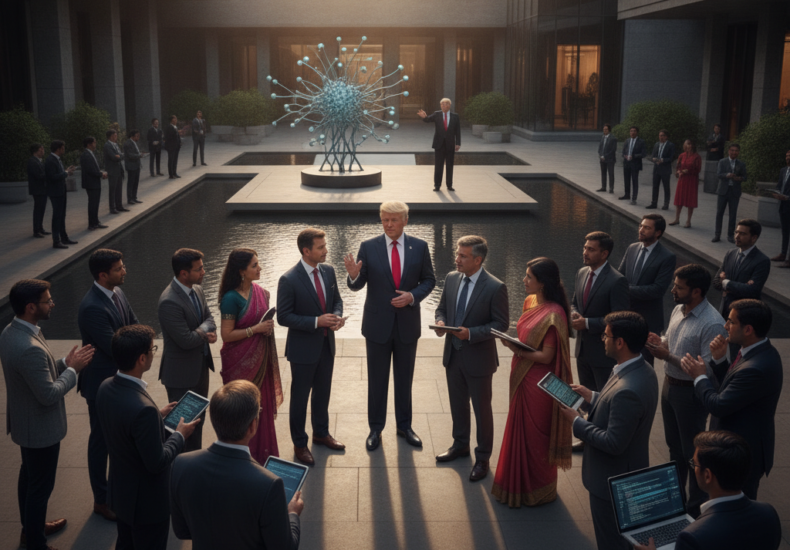
Trump names intelligence chief Jay Clayton as new White House AI czar as reflected on by Pandit Rajesh Sharma
Our temple courtyard here in the Silicon Hills often hums on Sunday evenings. Engineers, program managers, and research scientists remove their shoes at the threshold. They prostrate before the sanctum. Then they linger by the tulsi plant. They discuss model weights, national security, and regulatory oversight. News arrived recently about the new White House AI czar. The Director of National Intelligence received this concurrent appointment. Our congregants reacted swiftly. Indeed, consolidating intelligence gathering and machine intelligence under one overseer struck many as an inevitable milestone. However, this development also demands deep moral examination.
AI as a Modern Astra: The White House AI Czar’s Challenge
In Vedic thought, an instrument or weapon of formidable potency is known as an astra. Ancient epics describe astram as divine implements. They defend the righteous or devastate entire worlds. Crucially, the shastras never treated an astra as merely a neutral tool. Its invocation required adhikara, a qualified state of inner maturity. It also demanded rigorous tapas and a vow to uphold cosmic order. Without such spiritual discipline, wielding unchecked power inevitably brings destruction upon the wielder. Consequently, artificial intelligence, especially when bound to state intelligence and defense, represents a contemporary astra of staggering proportions.
During his confirmation hearings, the new appointee noted this technology is both a gamechanger and a profound threat. Students of Vedanta recognize that duality. The human intellect, or buddhi, possesses the faculty of discriminative wisdom, viveka. When buddhi anchors in dharma, it cultivates protection, truth, and genuine welfare. However, when severed from moral grounding, it degenerates. It becomes mere chaturata, a cunning cleverness. This cunning drives purely by paranoia, domination, and fear. Therefore, merging intelligence surveillance with synthetic computation risks magnifying fear rather than wisdom. It views humanity through the narrow lens of potential adversaries to be monitored.
Raja-Dharma and Ethical Stewardship
Many young professionals in our parish spend their workdays building these very architectures. They come to our study circles wrestling with karma yoga. This principle advocates selfless action performed without selfish attachment. They ask how their daily labors contribute to the world. Their innovations are so rapidly corralled by military and intelligence priorities. We remind them that they cannot abdicate action in the world. However, intention must be clarified. A builder who acts solely for institutional dominance incurs spiritual burden. In contrast, one who insists on ethical truth, accountability, and the protection of civil dignity walks the path of righteous duty.
Governance in our tradition fundamentally defines as raja-dharma. This sacred obligation compels rulers to foster an environment where all beings may pursue truth. They must flourish without fear. When governance becomes preoccupied with pervasive surveillance and weaponized computational dominance, it confuses control with protection. True strength does not arise from anticipating every citizen’s movement through predictive algorithms. Instead, it arises from fostering mutual trust, transparent justice, and compassion for the vulnerable.
As this new office takes shape in Washington, our prayer for its leadership remains clear. We pray their vision extends beyond national rivalry and tactical supremacy. The measure of any civilization lies not in the velocity of its computational engines. Nor does it lie in the breadth of its surveillance networks. It lies in whether its leaders possess the humility to recognize power without moral restraint is a peril to all. May those entrusted with this stewardship seek clarity over suspicion. Furthermore, may they remember that every technological leap must ultimately serve the dignity of the human spirit. This applies especially to the White House AI czar.
Leave a Reply