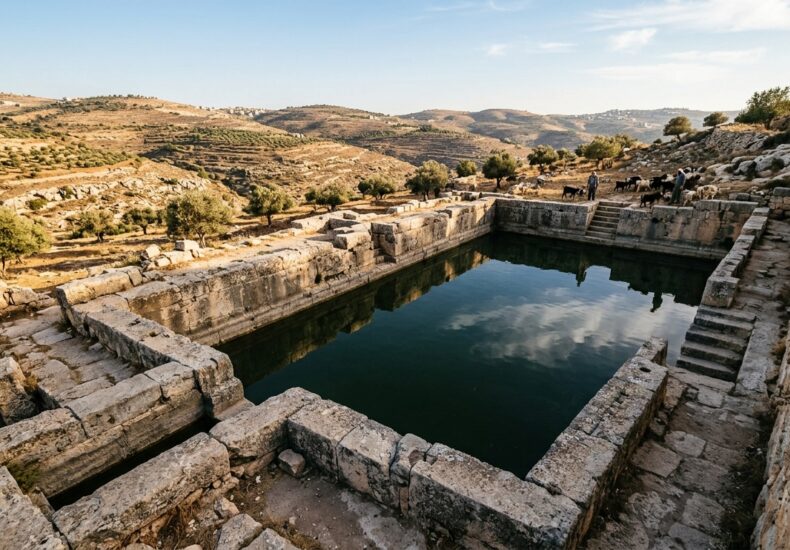
What is ‘Herod’s Pool’, and why is Israel developing it in the West Bank? as reflected on by Rabbi Aaron Klein
Between morning minyan and my early appointments, a congregant stopped me. He asked about water rights in Judea and Samaria. In our urban neighborhood, water seems an invisible, guaranteed utility. We simply turn a tap, and it flows. However, Jewish jurisprudence and biblical consciousness never treat water as a mere commodity. It is a primal divine blessing. Indeed, water represents the fundamental currency of life, and it tests human stewardship. The ongoing reporting surrounding the development of Herod’s Pool touches a raw nerve for many of us.
Water, Justice, and Herod’s Pool
We hold Jewish statehood and halakhic integrity in equal, sacred regard. Therefore, the archaeological remnants of our ancient past stir our historical souls. To walk near reservoirs carved during the Second Temple era is to brush against tangible ancestral memory. Yet, authentic Torah tradition never permits historical attachment or development initiatives to sever themselves from strict moral reckoning. This holds especially true when neighboring communities depend on the very same aquifers for basic survival. Our legal tradition speaks with remarkable clarity on riparian rights and common resources.
The Talmudic tractates of Bava Metzia and Bava Batra extensively discuss shared watercourses, well rights, and downstream obligations. The guiding principle is neither arbitrary dominion nor brute possession. Instead, it is justice rooted in equity and mutual preservation. Consequently, when someone diverts, channels, or monopolizes water in a way that deprives another human community of sustenance, the halakhic conscience must tremble. Sovereignty in Jewish thought is never absolute; it remains a fiduciary duty held under the Creator’s sovereignty. Therefore, the development of Herod’s Pool must meet this high standard.
Moral Foundations for Development
In our community, professionals regularly manage complex property disputes, municipal zoning battles, and international investment treaties. In every legal arena, civilized society recognizes a fundamental truth. Natural resources necessary for basic living cannot simply be claimed by whichever party possesses greater administrative or physical leverage. Furthermore, the Torah repeatedly commands us: “There shall be one law for the citizen and the stranger dwelling among you.” To oversee infrastructure that enriches one population while systematically diminishing another’s water security undermines our covenantal presence in the land. This practice erodes its moral foundation.
King Solomon warned against removing ancient boundary markers. Likewise, the prophets repeatedly excoriated leaders who built majestic edifices upon the deprivation of the vulnerable. When ancient infrastructure like Herod’s Pool is reclaimed, we must ask the central question. It cannot merely be who can develop it most efficiently or attract tourism. The true standard asks whether the development sanctifies God’s name through fairness, or whether it generates grievance and hardship. When water becomes a weapon of displacement rather than a shared blessing, the spiritual cost far outweighs any civic convenience.
Living in the diaspora while deeply invested in the Jewish state’s welfare requires honesty, not reflexive defensiveness. Love for the land of Israel becomes hollow if divorced from the moral demands of the Torah of Israel. If our return to sovereignty is to fulfill its prophetic purpose of being a light unto the nations, our governance must demonstrate impeccable rectitude. This applies to shared earth, springs, and reservoirs. True security and lasting peace will not be constructed upon parched ground. Instead, we build them upon policies that honor the dignity and essential needs of every person created in the divine image.

Leave a Reply