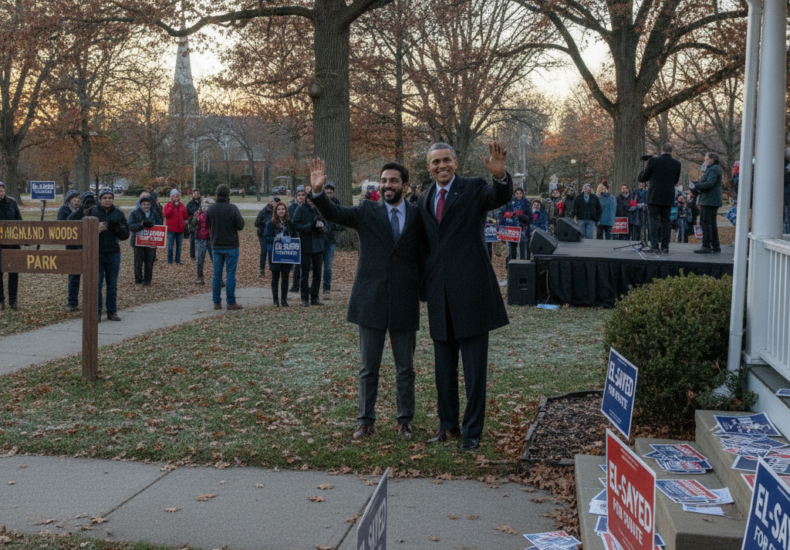
Obama to appear at Abdul El-Sayed rally in critical Michigan Senate race as reflected on by Rabbi Miriam Levin
Here in Highland Woods, October’s chill always brings campaign flyers to our porches. Lawn signs sprout in our manicured grass. At Congregation Kol Shalom, diverse political views enter our sanctuary each Shabbat. News of the former President Barack Obama traveling to Michigan for an Obama El-Sayed rally stirs familiar passions. A venerable party elder supports a younger, progressive candidate. This is standard electoral theater. However, a deeper question about generational covenant and public responsibility also arises.
Jewish tradition has always considered authority transitions. It also examines moral obligations tied to civic leadership. Pirkei Avot, the Ethics of the Fathers, teaches us to pray for government welfare. Without its order, people would surely swallow each other alive. Our tradition does not revere power for its own sake, however. When Moses transferred his mantle to Joshua, he did not just confer prestige. He transferred an immense burden of moral vigilance. When seasoned leaders elevate younger voices, they must transmit ethical substance. They should not merely consolidate partisan muscle.
Generational Covenant and Civic Duty
Abdul El-Sayed represents a new generation of leadership. He emerges from Michigan’s vibrant Arab-American and Muslim communities. He champions public health and systemic reform. As someone deeply engaged in regional interfaith councils, I know this. Minority communities need to see their daughters and sons step boldly into public life. At the same time, our suburban Jewish community experiences complex feelings with political shifts of this scale. People wonder about relationships and shared commitments. They also consider the future of civil dialogue when coalitions realign. Authentic coalition building demands sustained, difficult conversation. It cannot happen through photo opportunities alone.
The prophet Jeremiah instructed our ancestors in exile. He told them to seek the peace and welfare of the city where they dwelled. In its peace, they would find their own peace. Civic participation is not an indulgence of modern democracy. It is an ethical duty. We weave it into the fabric of covenantal responsibility. Early voting begins soon. Leaders will travel across states to mobilize the public. This serves as a vital reminder. The health of our common life depends on individual citizen decisions. Citizens must refuse apathy. A healthy democracy mirrors a healthy congregation. Every single soul is counted toward the sacred task.
Repairing a Fractured World
Political campaigns often reduce complex human communities. They turn them into blunt voting blocs. They measure enthusiasm solely by turnout percentages and fundraising receipts. Yet, the Jewish concept of Tikkun Olam, the repair of a fractured world, begins differently. It recognizes the unique dignity of each person. God created each in the divine image. True public service is measured by how laws protect the vulnerable. It safeguards public health. It also cultivates communities where our children can flourish without fear. When leaders share a stage, we must ask this: does their alliance heal social fractures? Or does it simply aim to win an election cycle? This Obama El-Sayed rally offers an opportunity for such reflection.
As the election approaches, I offer a prayer. It is for our congregation, our neighboring communities, and our nation. I do not pray for any single faction’s triumph. Instead, I pray for the elevation of our civic spirit. We need leaders of all generations. They must possess the humility to listen to critics. They need courage to bridge deep divisions. They also require the wisdom to remember this: power is temporary. However, the moral consequences of our governance endure for generations. May we approach the ballot box not in anger or fear. We must approach it with a sober devotion to the common good. This is our shared responsibility.
Leave a Reply