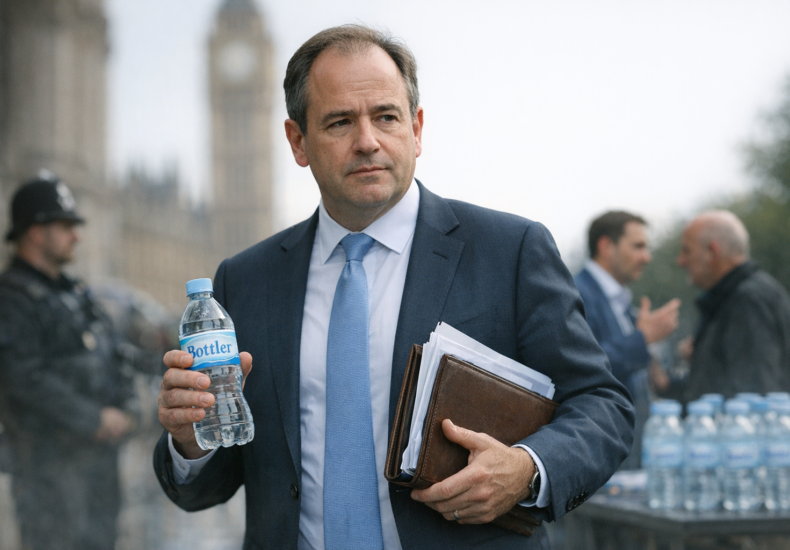
Shadow chancellor Andrew Griffith says Tories imposed too much regulation when they were in power – UK politics live as reflected on by Rabbi Miriam Levin
Political debates often reduce complex governance to marketing gimmicks. In Westminster, shadow ministers mock opponents with branded water bottles. They debate whether past administrations imposed too much **government regulation** on economic activity. From my study at Congregation Kol Shalom in Highland Woods, I observe quiet suburban streets. Families there juggle utility bills, childcare, and aging parents. This theatrical trivialization of public stewardship feels painfully disconnected from real human lives.
Jewish tradition never viewed regulation as an inherent evil. It is not an artificial impediment to personal liberty. The Talmud, in tractate Baba Batra, contains pages of debate. Our sages discussed municipal ordinances, property boundaries, and market protections. For example, they established rules preventing shopkeepers from unfair competition. They also regulated weights and measures with intense scrutiny. Furthermore, they required commercial polluters to locate operations far downwind from residential neighborhoods. The rabbis understood a crucial truth: unregulated self-interest does not produce a fair commonwealth. Left unchecked, it simply permits the strong to overwhelm the vulnerable.
The Parapet of Protection: Understanding Government Regulation
When politicians lament severe economic restrictions, we must ask a fundamental moral question. Freedom for whom, and at whose expense? In our suburban community, we see tangible results when oversight is treated as an inconvenience. It should be a protective hedge. When environmental regulations weaken, drinking water and air quality suffer first. This impacts less affluent neighboring towns. When financial rules are dismantled for “dynamism,” ordinary working households bear the brunt. They face inevitable economic volatility. Therefore, freedom in Jewish thought is never merely the absence of restraint. Instead, it is the presence of righteous obligation.
The Torah provides a clear paradigm for this balance: the mitzvah of the maakeh, the parapet. In Deuteronomy, we are commanded to build a guardrail around a new house’s flat roof. This prevents blood from coming upon our home if someone falls. A builder might protest that a railing adds cost or delays construction. It could also infringe on their aesthetic freedom. Yet, tradition insists that individual enterprise must always defer to communal safety. Every sensible safety standard, every environmental boundary, and every consumer protection represents modern society erecting a parapet upon its shared roof.
Covenantal Ethics and Public Discourse
Reducing urgent choices on energy, public investment, and communal protection to satirical stunt props profoundly fails public discourse. Our sages warned extensively against ona’at devarim. This is the sin of wounding another through speech and public humiliation. When serious policy disagreements over elections and infrastructure become juvenile jibes, the civic atmosphere suffers. It signals to our young people that governance is merely a game of ridicule. It should be an arena of sacred responsibility.
Here in our congregation, we often speak of covenantal ethics. This means recognizing that we exist not as isolated consumers seeking absolute license. We are partners bound in mutual responsibility to our neighbors and future generations. The challenges before us, whether transitioning our energy grid or sustaining local economies, demand disciplined cooperation. They require technical seriousness and genuine humility. Ultimately, they require leaders who understand true freedom. It is not found in discarding our guardrails, but in diligently tending the boundaries that keep the most vulnerable among us safe.

Leave a Reply