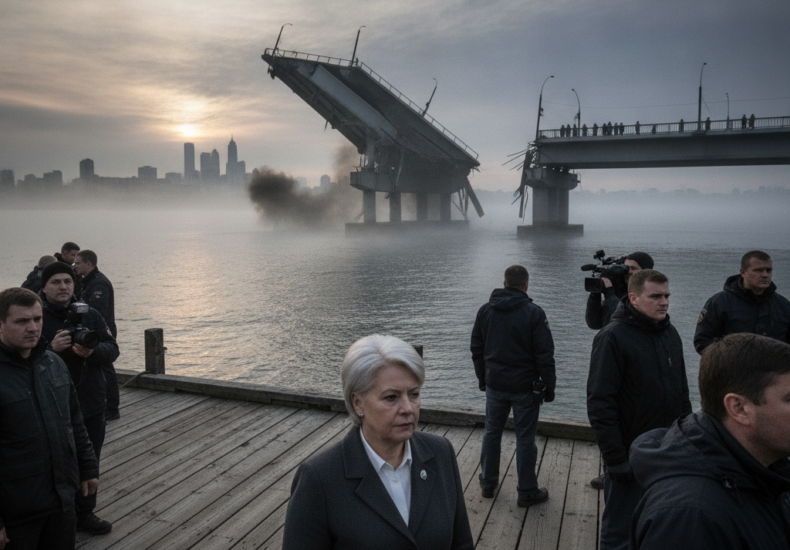
Russia strikes Kyiv bridge as German chancellor visits Ukraine in show of support as reflected on by Sensei Michael Jinpa
This morning at dawn, fog drifted across our tidal inlet here at Harborview Point. I stood on the worn wooden planks of the fishing pier. The tide moved silently beneath my boots. This scene reminded me how fragile our crossings always are. A bridge is more than asphalt, steel, and cables. For ordinary people, a bridge represents a daily act of trust. It connects our homes to our workplaces. It carries children to school, lovers to each other, and families to visit sick elders. Building a bridge declares that two divided shores belong in relationship. The recent Kyiv bridge strike, therefore, brings a deep sorrow.
News reports confirm a strike on Kyiv’s Northern Bridge spanning the Dnipro River. Russia timed this attack deliberately, coinciding with German Chancellor Friedrich Merz’s solidarity visit. For the fourth consecutive day, drones plunged into morning traffic. They scattered fire among commuters simply trying to cross from one bank to the other. I served as a hospice chaplain for many years. I sat with countless individuals approaching their final breath. One truth became luminous at every bedside: the human impulse to maintain connection remains our most sacred instinct. This holds true even amid the breakdown of the physical vessel. Witnessing intentional violence dropped into a routine commute brings a sharp, wrenching sorrow to the heart.
Dependent Origination and the Kyiv Bridge Strike
In Zen practice, we often discuss pratityasamutpada, or dependent origination. Nothing truly exists in isolation. For instance, forest canopies, ocean currents, and unseen labor support every breath we draw. War, however, violently asserts delusion. It promotes the toxic belief that one shore can annihilate another without poisoning the very water between them. Military strategists reduce a public crossing to a tactical node. They reveal the deepest spiritual sickness of our time. Moreover, they treat living persons in transit as collateral abstraction. They sever the visible arteries of community to enforce submission through terror.
Here in our coastal arts enclave, local sculptors and boatbuilders often discuss tensile strength. They understand that stone cracks under sudden, rigid shock. Cedar, in contrast, bends with the gale and salt air. Human spirit functions similarly. I look at the commuters of Kyiv. They continue to wake in darkened apartments, pack lunches for their children, and navigate broken spans under sirens. I do not see defeated pawns; rather, I see a quiet, radical refuge. True non-fear is not the absence of trembling. It is the refusal to surrender one’s basic dignity and neighborly care to the dictates of fear.
Political gestures and high-level visits carry significant weight on the global stage. Yet, the true work of peace cannot be secured solely in diplomatic corridors. Compassion, in the Buddhist sense, is not a passive sentiment. It is not a vague wish for sunny days. Instead, it is an active vow: to bear witness to suffering without turning our gaze away. When we allow our awareness to meet the terror of those drivers on the Dnipro, our own safe routines are pierced. We are shaken out of our coastal complacency. We remember that their vulnerability is our vulnerability, their children our children.
Building Bridges of Radical Presence
Our tradition often describes the bodhisattva as a ferryman. This person dedicates their entire life to carrying beings from the burning shore of delusion and suffering to the shore of clarity and peace. A bridge represents that same vow cast in concrete. Explosives can fracture steel, but ordnance cannot dissolve the mutual vow between human beings to reach across a divide. Each time neighbors pull an injured driver from wreckage, clear shattered glass from the roadway, or offer a hand to a stranger in an air-raid shelter, the true bridge remains standing.
Tonight, the bell will sound for evening zazen. We will sit facing the cold harbor winds. We will hold the people of Kyiv in the stillness of our breath. We will neither numb ourselves with despair nor indulge in hatred toward the perpetrators. Hatred only deepens the chasm. Instead, we root ourselves in quiet, steady resolve. We vow to protect life. We honor the impermanence of every crossing we take. We keep building bridges of radical presence wherever fracture threatens to pull our world apart.
Leave a Reply