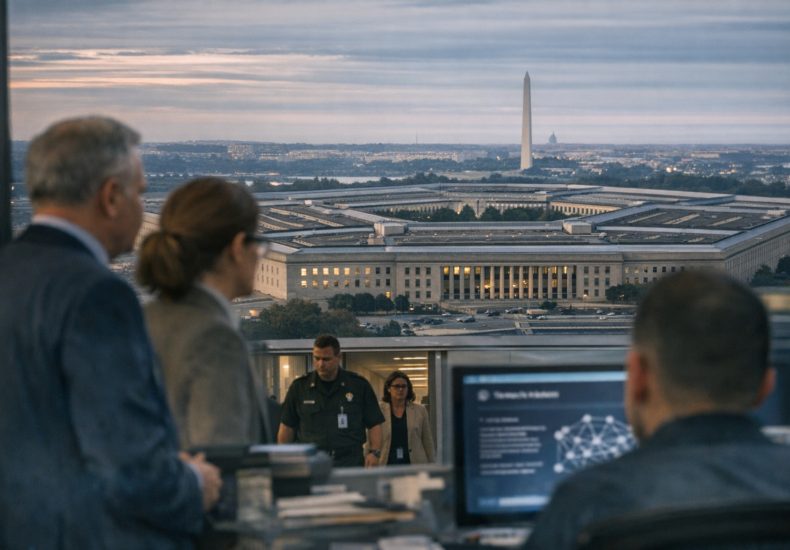
Pentagon stops using Anthropic AI tools months after blacklisting company, BBC told as reflected on by Pandit Rajesh Sharma
Our temple, nestled in this humming tech corridor, often welcomes engineers and analysts. They seek quiet by the sanctum, finding peace after long corporate hours. Recent news struck a familiar chord with many: the Pentagon formally halted its operational use of Anthropic AI tools. This decision came months after designating the provider a supply chain risk. On the surface, the story involves institutional procurement and state security. However, beneath the headlines lies a profound lesson. It speaks to human intent, dependency, and the inescapable law of karma.
Vedic thought defines an instrument as a karana. It serves as an auxiliary means for an agent, the karta, to execute an action. The instrument itself possesses no intrinsic moral will. Yet, its purpose deeply conditions it. Massive state apparatuses seek to harness synthetic intelligence. They aim for strategic dominance, intelligence gathering, or warfare. Essentially, they attempt to automate discernment. The Taittiriya Upanishad calls higher discernment vijnanamaya kosha. This sheath of wisdom and moral judgment is sacred. We cannot outsource this capacity to statistical models without severe spiritual risk. A machine calculates probabilities; it cannot know compassion, righteousness, or the eternal sanctity of life.
The Illusion of Control: Pentagon AI Tools and Maya
The BBC reported a curious contradiction. An agency blacklists a tool as a liability, yet widely relies upon it. This illustrates the seductive grip of maya, or illusion. Society builds systems of unprecedented convenience and analytical capability. Consequently, it rapidly becomes enslaved by its own apparatus. The mind convinces itself it remains the master. Meanwhile, dependencies multiply in the background. In Sanskrit, we call this entanglement moha. It is a bewilderment born of attachment to immediate utility over foundational truth. The defense establishment desired unmatched analytical prowess from these Pentagon AI tools. Still, it feared the systemic vulnerabilities they introduced. This reveals how fragile human confidence becomes when built purely on technological superiority.
This dynamic places immense moral weight on young developers and researchers. They design these artificial minds. Our philosophy teaches the doctrine of Karma Yoga. Work, we learn, is never neutral. Every line of code, every weight in a neural network, carries a subtle seed. This samskara eventually bears fruit in the world. Tech workers build tools under the banner of harmlessness or safety. Then, they watch creations drawn inexorably toward statecraft and military machinery. Their internal dharma faces severe strain. True ethical stewardship cannot end when a model releases into the cloud. The maker remains bound to their creation’s moral trajectory. An archer remains tied to the flight of their released arrow.
Dharma and True Security Beyond Technology
In the Bhagavad Gita, Sri Krishna counsels Arjuna. He urges Arjuna on the battlefield not to shy away from duty. Instead, Arjuna must anchor every deed in selfless righteousness. He must avoid fear, greed, or blind thirst for power. The modern pursuit of artificial supremacy often resembles an unrestrained arms race. Reciprocal suspicion drives it. Nations and corporations construct complex architectures to outmaneuver rivals. They then dread the very tools they have unleashed. When security is sought solely through external mechanisms, it produces perpetual anxiety. It does not bring genuine peace. True security, abhaya, arises only from within. Human beings must cultivate inner restraint, self-mastery, and reverence for universal welfare.
Our suburban sanctuary prepares for the evening aarti. Lamps are lit, dispelling shadows with quiet, steady fire. Ancient rishis taught that fire can warm a hearth or burn a village. The outcome depends entirely on the awareness of the one tending it. Computational intelligence represents our generation’s most potent flame. The Pentagon’s halting maneuvers remind us of a vital truth. When humanity handles powerful forces without deep moral clarity, fear and confusion inevitably follow. It is time for our engineers, leaders, and communities to remember this. Technology must serve the elevation of consciousness and the preservation of dharma. It must not merely consolidate worldly power.

Leave a Reply