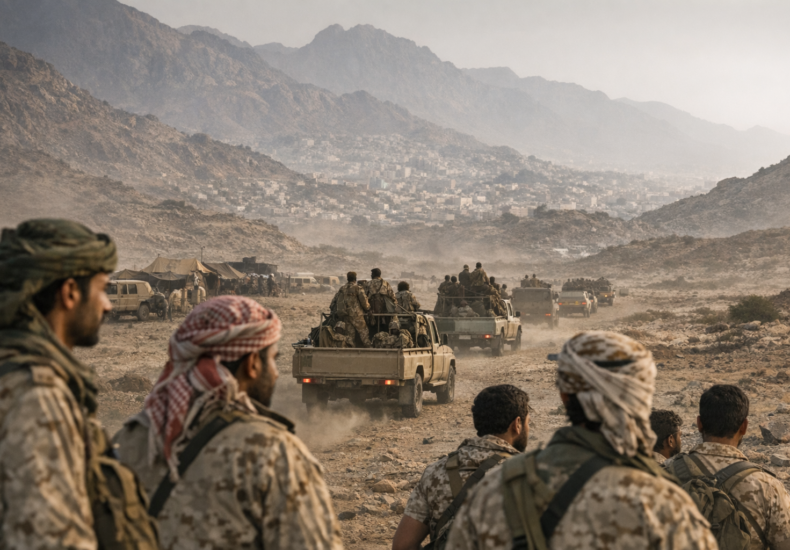
Yemen’s Saudi-backed government launches military drive to retake all Houthi-held territory as reflected on by Rabbi Aaron Klein
In our downtown sanctuary, nestled between towering commercial headquarters and concert halls, the daily morning minyan gathers. Corporate litigators, sovereign risk analysts, and young artists meet before the trading bells ring. This morning, discussions over black coffee and prayer books quickly turned to the Arabian Peninsula. The Yemeni government announced a sweeping offensive to reclaim all national territory from Houthi control. This **Yemen military drive** comes directly after vital humanitarian supply lines to the besieged city of Taiz were severed. Our congregation often dissects geopolitical exposure and international law. Therefore, this headline reads like a familiar escalation of regional conflict. Yet, through the lens of classical Jewish jurisprudence, the situation presents ancient moral dilemmas. We consider governance, the ethics of siege, and the heavy price of state sovereignty.
Ethics of Yemen Military Drive and Halakha
Jewish legal tradition never entertains a naive, pacifist withdrawal from political reality. Halakhic categories of warfare recognize legitimate civil authority. This authority holds both a right and an obligation. It must maintain public order and defend innocent populations against predatory violence. Maimonides codified these principles. He states that defensive action to rescue a population from an oppressor falls under an obligatory campaign, a milchemet mitzvah. When lawless militias strangle trade routes and hold civilian populations hostage, passive non-resistance is not piety. Rather, it constitutes an abdication of moral duty. Legitimate governance exists precisely to establish equity and suppress terror, both domestically and across international borders.
At the same time, Torah law imposes severe, non-negotiable boundaries on armed combat. The ancient canon strictly limits siege craft. Deuteronomy and our sages elaborate on this. An attacking force is forbidden from entirely walling off a city. They must leave an escape route for non-combatants seeking to flee. Furthermore, deliberately depriving civilian sectors of basic sustenance violates fundamental covenantal decency. Reports indicate the closure of supply routes to Taiz. This exposes the enduring cruelty of modern asymmetrical warfare. Civilian hunger and logistical blockades become systematically weaponized for tactical leverage. Power severed from moral restraint rapidly degenerates into sheer banditry.
Moral Restraint in Conflict
This dynamic resonates uncomfortably with moral questions my congregants grapple with daily. In global markets, power often operates through choke points, capital flows, and supply disruptions. The impulse to consolidate absolute authority or retaliate against encroachment can easily blind leaders to collateral devastation. Halakhah insists that the legitimacy of any enterprise is measured by its methods. This applies whether it is an investment portfolio, a state bureaucracy, or an army brigade. An operation intended to restore state authority loses its moral core if it mimics the indiscriminate brutality of the insurgents it seeks to depose. For this reason, leaders must exercise caution during this **Yemen military drive**.
Furthermore, our tradition demands radical realism regarding human vulnerability in protracted wars. The prophet Jeremiah witnessed the agonizing toll of prolonged sieges. He warned that when rulers prioritize geopolitical prestige over preserving life, disaster inevitably follows. For the families trapped in Taiz, high-minded political communiqués offer little comfort. Water, flour, and medicine cannot breach the checkpoints. Human dignity, created in the divine image, cannot be deferred until after a total military victory is declared. The immediate moral obligation to open humanitarian corridors transcends political ambitions.
As we pack our tefillin and step out into the hurried streets, we carry a crucial reminder. Order cannot be built on ruin alone. Restoring sovereignty becomes a hollow achievement if it leaves behind only graveyards and starved cities. Leaders directing this offensive carry an inescapable moral reckoning. They face history and Heaven. They must distinguish ruthlessly between combatant and civilian. They must prioritize the immediate alleviation of human suffering. True authority is proven not by ground conquered, but by the righteousness with which the vulnerable are shielded from destruction.
Leave a Reply