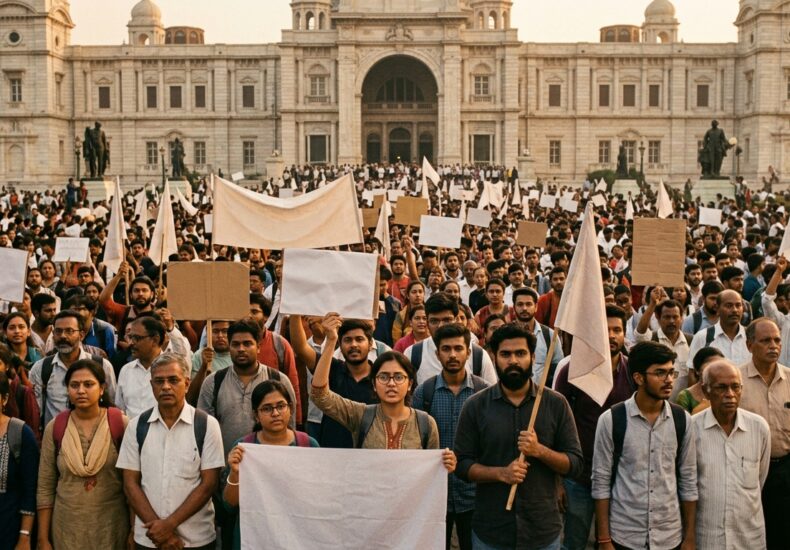
Mass protests demanding poll chief resignation shake India for third day as reflected on by Rabbi Miriam Levin
Our tradition never treats counting human beings as a mere administrative chore. The Book of Numbers opens with a divine command to take a census. However, Jewish law carries an ancient hesitation. We avoid reducing people to cold tallies. Rashi and the sages taught us this. Every individual soul must be accounted for through an offering. This acknowledges each person’s irreducible, sacred worth. We recognize counted individuals as essential stakeholders in the covenant. Conversely, erasure from the record becomes a quiet form of spiritual and civic disenfranchisement. The ongoing India poll protests highlight this deep concern.
Reports from India describe massive crowds filling public squares. Millions of citizens find their names excised from voter rolls. This ancient tension resonates immediately. Demonstrators demand accountability from election officials. They fear bureaucratic revisions are weaponized. Vulnerable populations risk losing their voice. Across continents and legal systems, the grievance strikes the same moral nerve. Waking up to find the state no longer acknowledges your presence creates profound indignity.
The Sacred Weight of Civil Personhood
Here in Highland Woods, our congregation sits in a leafy suburban enclave. We often take civic machinery for granted. We receive glossy sample ballots. Our polling places are well-staffed. Our municipal disputes rarely threaten basic enfranchisement mechanics. Yet, in my study at Kol Shalom, I see something else. I sit with congregants across our multi-faith council. I talk with young people anxious about global democracy’s fragility. Comfortable distance easily breeds complacency. We forget that any governing order’s legitimacy rests entirely on consent. The widespread India poll protests serve as a stark reminder.
The Talmud in tractate Sanhedrin reminds us: destroying a single life is like destroying an entire world. Similarly, preserving a single life preserves an entire world. We often invoke this teaching for physical life and death. However, it also speaks to civil personhood’s ethical weight. An electoral register discarding tens of thousands of names is not an abstract bureaucratic error. It is a systematic silencing of distinct worlds. Individuals whose daily labor, hopes, and dignities are arbitrarily pushed into political invisibility face this reality.
Vigilance: A Spiritual Duty
Rabbinic ethics have long recognized procedural fairness. It forms the bedrock of societal peace. In Pirkei Avot, Simeon the Righteous taught that the world endures on three pillars: justice, truth, and peace. Crucially, our commentators noted that peace cannot exist without justice. Justice also cannot exist without truthful process. When public will’s recording machinery becomes suspect or opaque, foundational trust crumbles. Mass protests rarely stem from sudden impatience. They erupt when people perceive that formal redress mechanisms have closed against them. This understanding illuminates the current India poll protests.
At Congregation Kol Shalom, we often reflect on Tikkun Olam. This mandate calls for the repair of a fractured world. Too often, people reduce this principle to simple private charity. True repair, however, demands more. We must confront institutional fractures. We see power consolidate by shrinking the circle of participation. A society does not become righteous merely by holding regular votes. It proves its righteousness by guarding every neighbor’s sacred right. Especially the poorest and most marginalized must cast their vote and be seen. We watch our brothers and sisters in India take to the streets. Their struggle reminds us that vigilance is a spiritual duty. A nation’s health is not measured only by economic output or charismatic leaders. We measure it at the margins. The least powerful citizen must stand before an official registry. They must know, without fear or suspicion, that their name is written and their voice counts.
Leave a Reply