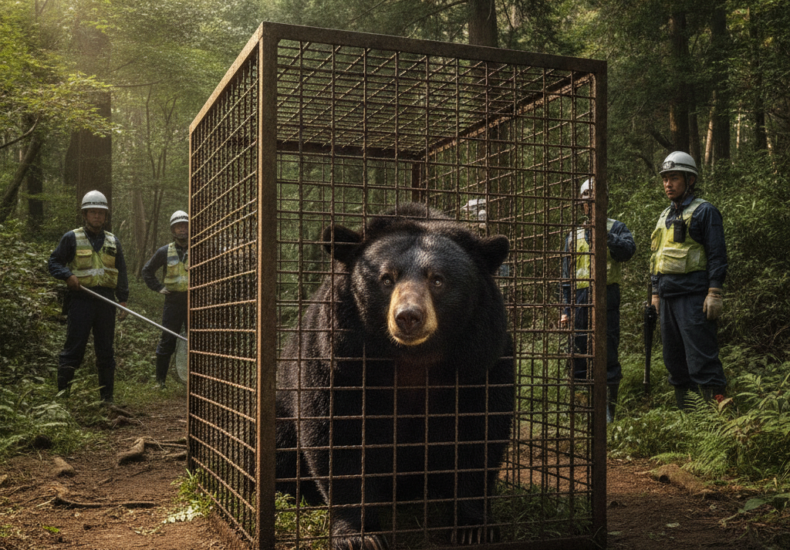
Black bear caught in Japan after days of sightings as reflected on by Swamini Ananda Saraswati
The recent news of a black bear capture in Utsunomiya, following increased sightings and a record number of Japan bear attacks, brings a poignant reflection to our Ganga Mandir Sanctuary. We observe this situation not merely as an isolated incident, but as a symptom of a deeper imbalance. Humanity’s increasing encroachment into wild spaces inevitably creates friction. Therefore, this event calls us to examine our relationship with the natural world and the consciousness that animates all beings.
The Dharma of Ahimsa and Shared Space
From the perspective of Advaita Vedanta, a singular consciousness pervades every form of life. The bear, like us, manifests this universal Spirit. Consequently, Ahimsa, the principle of non-harm, extends beyond human interactions to encompass all creatures. When humans and animals clash, we must question our role in disrupting established ecosystems. Furthermore, these conflicts arise when our own technological expansion disregards the inherent rights of other species to their natural habitat. We must remember our interconnectedness, therefore, and strive for harmonious co-existence.
The escalating Japan bear attacks compel us to consider the bears’ perspective. Their natural food sources diminish; their ancestral territories shrink. They move into human areas out of necessity, not malice. We project our fears onto them, yet they simply seek sustenance and survival. Ultimately, we share this planet. Our spiritual practice teaches us to see the Divine in all, cultivating compassion even for those we perceive as threats. This vision helps us find peaceful solutions.
Cultivating Inner Equilibrium for Outer Harmony
Our technological advancements often foster a sense of separation from nature. We build walls, both physical and metaphorical, between ourselves and the wild. This separation, however, stems from a deeper internal disequilibrium. When we lose touch with our own inner stillness, our actions externalize this lack of peace, impacting the environment and its inhabitants. We must therefore transcend the technological ego, which mistakenly believes in dominance over nature.
Restoring balance requires a shift in consciousness. We must cultivate inner equilibrium through meditation and self-inquiry. This practice reveals our non-dual identity with all existence. Consequently, our actions become more mindful, more compassionate. We seek solutions that honor both human safety and animal welfare, understanding that true security comes from harmony, not control. We learn to respect the boundaries of the wild, allowing space for all beings to thrive naturally. This wisdom guides our path forward.
Read the original news coverage on BBC News (World).

Leave a Reply