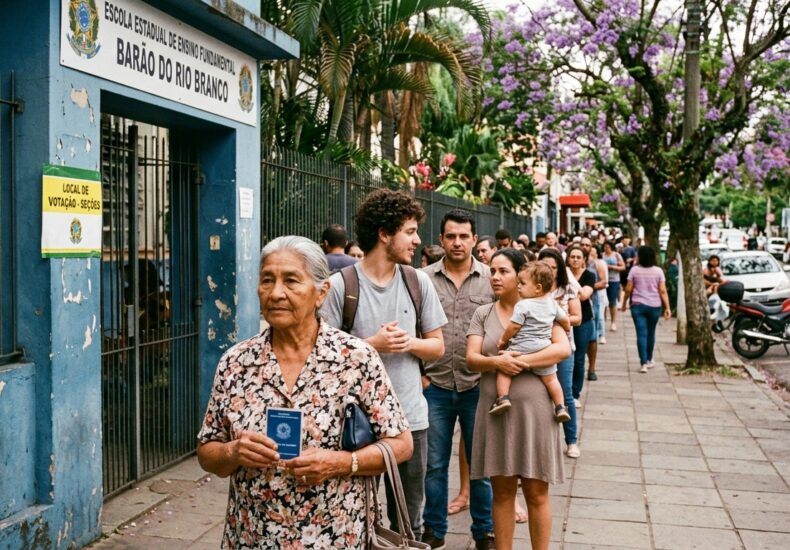
The Guardian view on Lula v the Bolsonaros: the decision of Brazilian voters will affect us all | Editorial as reflected on by Rabbi Miriam Levin
In our quiet Highland Woods sanctuary, autumn winds often create an illusion of insulation. We gather on Shabbat, share coffee, and check on neighbors. We try to believe the world beyond our leafy streets can be kept at arm’s length. Yet, every morning, the news dissolves that comfortable border. The report on Brazil’s knife-edge presidential contest between President Luiz Inácio Lula da Silva and Flávio Bolsonaro makes this painfully clear. Flávio is the son of the jailed former president who sought to dismantle democratic structures. This struggle shows no community lives in an isolated garden. The **Brazilian election impact** will resonate directly into our shared planet’s moral atmosphere.
Jewish tradition understands governance as a covenantal responsibility, not a spectator sport. In the Talmud, Tractate Avodah Zarah, Rabbi Hanina teaches, “Pray for the welfare of the government.” He adds, “Were it not for the fear of it, people would swallow each other alive.” The rabbis did not naively venerate emperors. On the contrary, they remembered Roman oppression acutely. They recognized that legitimate civic order prevents predatory chaos. When political life deteriorates into dynastic vengeance, candidates seek to pardon lawbreakers and dismantle accountability. Therefore, the foundational fence protecting human dignity begins to buckle. This deeply concerns us.
Choosing Justice in Brazil’s Election
The electorate’s exhaustion particularly strikes me with sorrow. Observers note many citizens are not casting ballots out of genuine hope. They lack shared civic aspiration. Instead, they vote out of visceral contempt for the opponent. Most voters reportedly disapprove of both men. In the Kol Shalom counseling room, I often sit with congregants spiritually depleted by modern politics. They feel paralyzed by civic life, which seems only a choice between rival forms of hostility. In Jewish ethics, this is the corrosive poison of sinat chinam, baseless hatred. When fear and mutual disgust fuel democratic participation, society consumes itself from within. We must avoid this outcome.
This election also carries profound ecological stakes. These touch the core of our spiritual obligation to creation. When God placed humanity in the Garden of Eden, the mandate was l’ovdah u’l’shomrah, to cultivate and to protect. The Amazon basin is not merely Brazilian sovereign territory. It functions as the very lungs of the biosphere. Political forces aligned with the former regime treated that sacred canopy as a resource to be plundered for rapid profit. They scoffed at environmental protections and indigenous rights. Therefore, choices made by voters will determine whether an ecosystem vital to every living soul is preserved. Alternatively, it could be pushed past an irreversible threshold of ruin. To destroy God’s creation for short-term political spoils is a desecration of the Divine Name. This is a critical aspect of the **Brazilian election impact**.
Upholding the Rule of Law and Collective Memory
Furthermore, the contest tests our collective memory and capacity for justice. Jair Bolsonaro’s imprisonment for plotting a coup was a rare and necessary assertion. It proved the rule of law applies even to the powerful. For his son to campaign on undoing those verdicts and freeing those who ransacked state institutions reveals brazen contempt for legal truth. In Deuteronomy, our ancestors were commanded, “Justice, justice shall you pursue.” Our sages famously asked why the word justice repeats twice. One enduring rabbinic insight states both the ends and the means must be just. A democratic process cannot endure if one side treats institutional destruction as a legitimate card. This applies whenever a vote does not go their way.
At our suburban interfaith council meetings, we frequently grapple with maintaining civil dialogue. The political ground shifts under our feet. Brazilian citizens face an extreme, intensified version of this spiritual dilemma. Democracies everywhere ask: how do we summon the resolve to vote for stability, civic peace, and environmental preservation? This holds true even when candidates are deeply flawed. Despair is an easy indulgence, but Judaism insists despair is an ethical surrender. We are taught in Pirkei Avot that it is not our duty to complete the work. However, neither are we free to desist from it. We must act.
This weekend, my prayers go out to the people of Brazil. They carry the heavy burden of deciding their democratic institutions’ fate. They also decide our shared home’s ecological future. May they find the collective wisdom to choose accountability over retribution. May they preserve creation over its plunder. Finally, may they choose the difficult work of civil renewal over the seductive anger of grievance. In an interconnected world, their courage protects us all. Ultimately, their choice shapes our shared destiny.
Leave a Reply