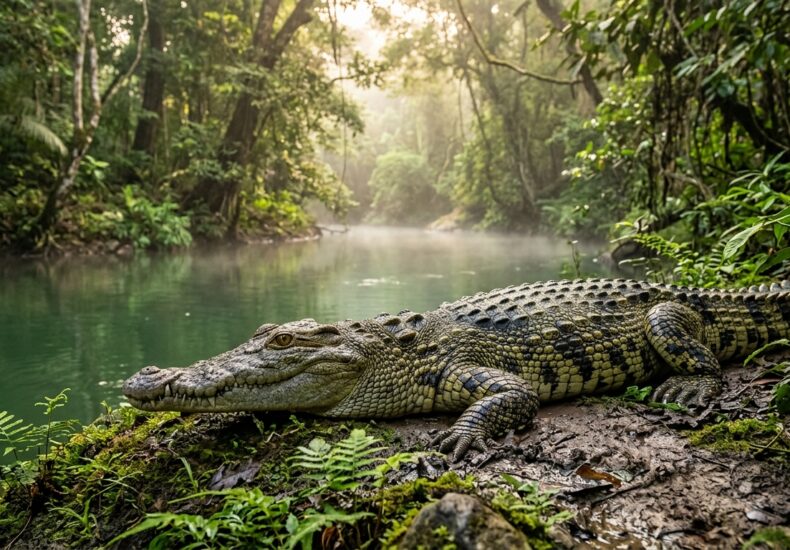
Saving the Siamese crocodile: Cambodia moves to protect one of the world’s last wild populations as reflected on by Sensei Michael Jinpa
Before dawn settles over Harborview Point, the tide pulls back from the mudflats beneath our zendo. Quiet pools of salt water remain. Herons wait motionless there. In Zen, we practice that same deliberate stillness for hours. We learn to look beneath our minds’ agitations. News arrived this morning of Cambodia establishing protected wetland sanctuaries. This move ensures the critical Siamese crocodile protection. I immediately thought about life’s hidden currents. They persist long after modern hubris pronounces them dead.
For decades, international experts assumed this ancient reptile had vanished. Poaching and industrial encroachment, they believed, had driven it entirely into oblivion. Yet, deep in the Cardamom mountains, the Indigenous Chorng people knew otherwise. They lived alongside these creatures. They saw them not as resources or problems. Instead, they recognized them as fellow kin within a shared ecological mandala. Their attentiveness rooted itself in reverence and ancestral memory. Therefore, they held the thread of survival when the rest of the world had already looked away.
The Wisdom of Faithful Presence for Siamese Crocodile Protection
During my years as a hospice chaplain, I often witnessed a cultural pattern. Our society tends to turn its back on what appears broken, diminished, or already lost. We suffer from spiritual impatience. It values only what is immediate, profitable, and easily cataloged. When something seems beyond repair, our instinct is to abandon it. We numb ourselves to the grief. However, the survival of the Siamese crocodile exposes cynicism’s poverty. Extinction was averted not by abstract theory. Instead, it resulted from the grounded, faithful presence of people. They never severed their relationship with the marshlands.
In the Buddhist contemplative path, we study dependent co-arising’s truth. This reality teaches that no creature exists in isolation. The crocodile, the wetland sedge, the mountain rainfall, and the human community form a single, seamless fabric. When one strand is severed, the entire weave suffers. Protecting a prehistoric reptile in a distant wetland is not merely a technical exercise in conservation biology. It is, furthermore, an act of ethical repair. It restores our vow to live harmlessly among our relations.
Cultivating Radical Compassion
Here along the harbor, our artists and fishermen often speak of fragility. Fragile shorelines slip into degradation easily. This happens when people treat the water as nothing more than a scenic backdrop or an extraction zone. Real care requires intimacy. Moreover, intimacy requires humility. The Chorng elders did not need scientific instruments to confirm the crocodile was still breathing among the reeds. They possessed moral clarity. This clarity comes from generations of reciprocal living, an attunement modern society desperately needs to recover.
Radical compassion asks us to extend our circle of care. This circle must reach far beyond beings that are gentle, familiar, or convenient to love. A predatory crocodile wallowing in mountain silt carries the very same Buddha nature as a child playing along our wharf. Each holds a sacred place in the living world. When we create space for an ancient species to endure, we quietly heal a fracture within our own humanity. We acknowledge that the earth does not belong to us alone. Consequently, this deepens our connection to all life.
As the morning bells ring through the fog of Harborview Point, I offer a silent bow to the caretakers in the Cardamom valleys. Their patience reminds us of a profound truth. Even when destruction seems absolute, the seed of renewal often waits quietly in the shadows. Our task is simple. We must quiet our restless hands. We must listen to those who remember how to live in balance. Ultimately, we must make room for all life to abide.
Leave a Reply