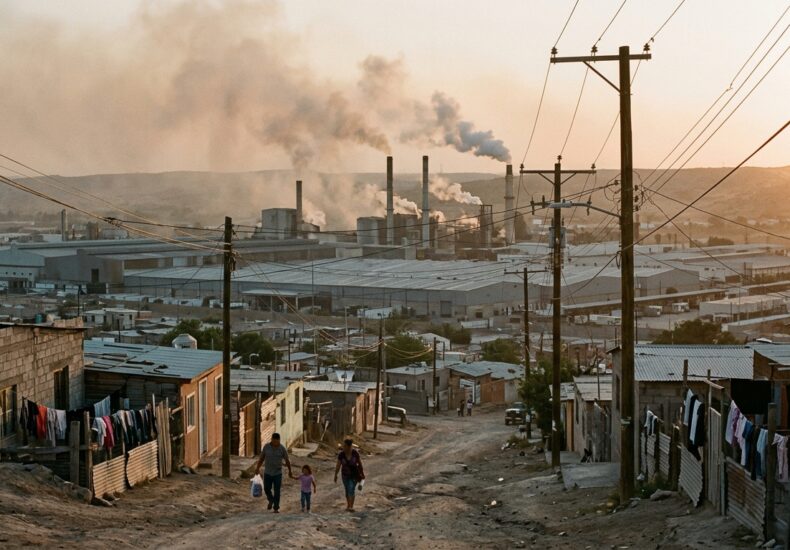
Revealed: Mexico’s industrial boomtown is making goods for the US. Residents say they’re ‘breathing poison’ as reflected on by Imam Tariq Al-Mansoor
Every morning after the dawn prayer at Al-Fajr, I stand outside on the steps of our center. I watch Cedar Heights awaken. Delivery trucks rattle down our narrow avenues. The distant exhaust from the interstate settles like a thin film over our brick rowhouses. Many congregants, especially children and the elderly, carry rescue inhalers. I read reports from Monterrey, Mexico. Working families there describe literally breathing poison so assembly lines can churn out goods for northern markets. The geography may differ, but the moral reality feels intimately familiar.
In the Islamic tradition, creation is not an inert playground for exploitation. Nor should anyone consume and discard human labor. We learn that humanity accepted the amana, the sacred trust of stewardship over the earth. Part of that trust is the universal, unassailable right of every living soul to God’s common gifts. These gifts include clean water, uncorrupted soil, and the breath of life itself. Industrial cartels poison entire valleys to shave pennies off supply chains. Therefore, they violate this trust at its root. They treat God’s creation as an unpaid dumpster. Furthermore, they treat working families as collateral damage.
Industrial Greed and Breathing Poison
The Prophet Muhammad, peace and blessings be upon him, established a fundamental legal and spiritual maxim. He taught, “There shall be neither infliction of harm nor reciprocation of harm.” This principle of la darar wa-la dirar cuts directly through modern corporate accounting. A transaction cannot be called mutually beneficial or lawful if its hidden cost is the respiratory ruin of an entire neighborhood. Exporting filth across an international border does not wash the hands of those who commission the labor. Distance and borders may obscure legal liability in earthly courts. However, they do not diminish the moral culpability of outsourcing suffering, especially when people are breathing poison.
Here in Cedar Heights, we organize alongside our neighbors across different faiths. We know that environmental degradation always tracks the path of least political resistance. Factories and smokestacks rarely appear where corporate executives raise their families. They are planted where working people are too exhausted, too disenfranchised, or too precarious to mount expensive legal battles. In Monterrey, multinational conglomerates from across the globe build fortunes on the lungs of mothers, fathers, and children. These families simply seek honest wages to feed their households. This is not mere economic expansion; it is systemic injustice.
Accountability for Our Shared Soul
The Quran warns humanity against spreading mufsidun, corruption and ruin, across the earth. This often happens under the pretense of progress or development. When questioned, transgressors often claim they are merely reformers, modernizers, or engines of commerce. Yet, true prosperity can never be measured by quarterly earnings or polished export tallies. The ground reality often leaves children gasping for air behind closed windows. Wealth generated through the degradation of human life carries no spiritual blessing. It is hollow gain accumulated at the expense of our shared soul.
As believers and conscientious citizens, we cannot look at the items lining our store shelves with moral indifference. Civic virtue demands that we trace the chain of consequence behind the goods we consume. It requires us to stand in solidarity with those whose communities are sacrificed to fuel foreign convenience. We must demand rigorous accountability. Enforceable clean air standards are essential. Corporate liability must refuse to stop at national boundaries. True faith is never confined within the walls of a prayer hall. Instead, it insists on fighting for the breath and dignity of the vulnerable wherever they reside.

Leave a Reply