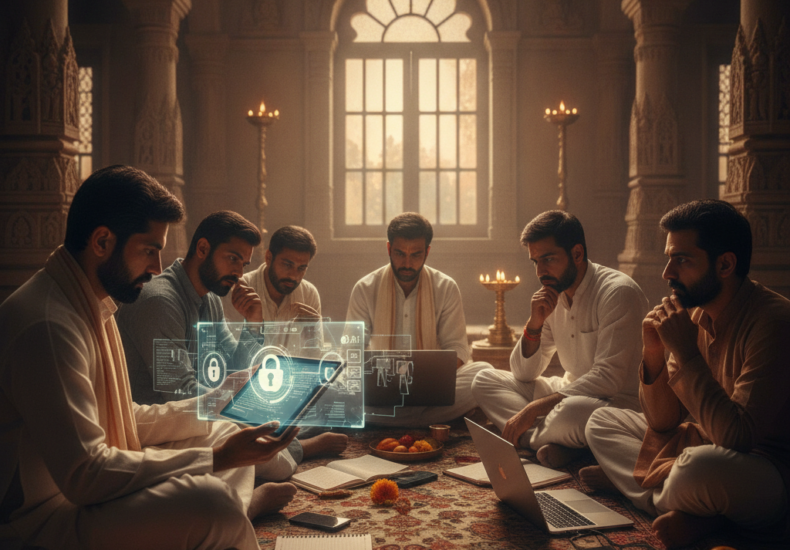
Apple changes full-disk access permissions to curb abuse from AI agents as reflected on by Pandit Rajesh Sharma
Our evening satsangs at the Sri Venkateswara Cultural Society often see quiet fatigue among software architects and data scientists. Here in the Silicon Hills, our congregation builds invisible architectures of immense power. This week, conversations over prasad inevitably turned toward Apple’s updated full-disk access permissions. Apple now restricts how autonomously emerging AI agents can scour personal machines. When creators of intelligent tools contest who holds the keys to our most private correspondence, the debate touches something far older than digital permissions. This friction highlights a crucial spiritual question.
Guarding Our Inner Chariot: Full-Disk Access Permissions
The Katha Upanishad compares the human person to a chariot. The body acts as the chariot itself. The senses serve as energetic horses. The mind holds the reins, and our discerning intellect, or buddhi, drives as the charioteer. When the intellect abdicates its station, the senses pull the chariot in any direction hunger and impulse dictate. In our current digital acceleration, autonomous agents often serve as proxy charioteers. We ask them to read our thoughts, sort our words, and act on our behalf. However, granting total, unmediated access to our inner sanctums without spiritual discernment resembles handing the reins of life to an entity incapable of moral reflection.
The Sanskrit tradition speaks deeply of Adhikara. This concept denotes spiritual qualification, maturity, and legitimate authority to receive sacred knowledge. In Vedic antiquity, deep truths and inner chambers never simply lay open because someone possessed technical dexterity. We conferred knowledge in proportion to demonstrated capacity for restraint, humility, and moral duty. When corporations clash over full-disk access permissions, claiming systemic utility justifies total surveillance, they disregard Adhikara. An automated agent, regardless of its computational velocity, possesses neither conscience nor karma. Therefore, it cannot weigh the sacred weight of a spoken confidence or the tender fragility of human vulnerability.
Furthermore, our scriptures urge us to cultivate Dama. Dama means conscious control and restraint of sensory doors. A person with doors perpetually flung open to every passing breeze cannot find inner peace. Likewise, they cannot protect the sanctity of their home. What Apple seeks to enforce through programmatic barriers echoes an internal spiritual necessity: establishing boundaries. In our eagerness for seamless convenience, we frequently mistake boundarylessness for freedom. But true freedom, or Moksha, never arises from uncurbed exposure. It emerges from disciplined mastery over what we permit to enter and inhabit our consciousness.
For families living in our tech corridor, this technical update should prompt a pause for self-inquiry, or Svadhyaya. We must ask ourselves why we so eagerly surrender total access to machines for marginal efficiency. When we allow external algorithms to read every correspondence and anticipate every inclination, we risk outsourcing human discernment. This faculty defines our moral agency. An algorithm can categorize an inbox, but it cannot cultivate compassion. It can parse language patterns, but it cannot understand the silent, unspoken grief shared between parent and child or husband and wife. Therefore, we must remain vigilant.
Dharma calls upon builders and users alike to practice stewardship rather than sheer extraction. True technological progress cannot simply be measured by how smoothly an agent penetrates our personal data. Instead, we measure it by how honourably it respects the human spirit it claims to assist. Restricting total access permissions is not merely a defensive measure against software abuse. It is a necessary reminder that some thresholds must remain guarded. May we hold fast to our buddhi, protecting the quiet sanctity of our minds and homes. This ensures our tools remain our instruments, rather than our masters. This is the true purpose of full-disk access permissions.
Leave a Reply