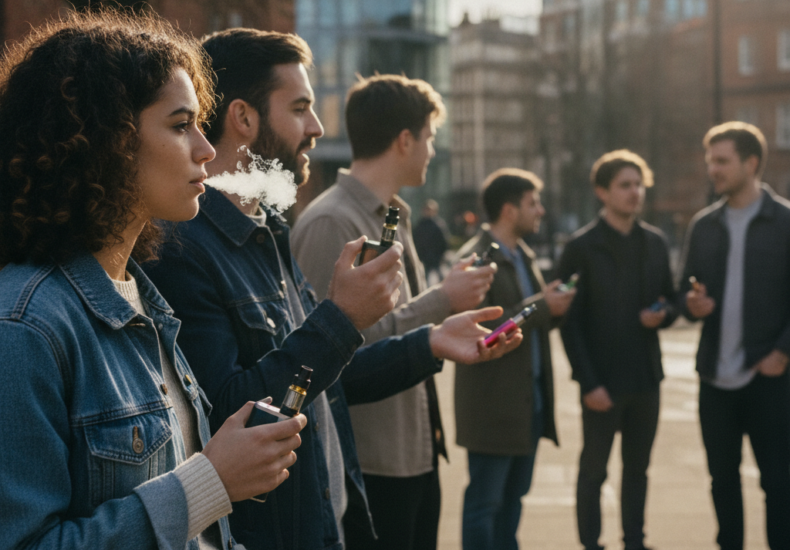
Proportion of people in Great Britain vaping who never smoked doubles in four years as reflected on by Rabbi Leah Ben-Zion
The Office for National Statistics recently reported a concerning trend. Over one million people in Great Britain now engage in **vaping never smoked** traditional cigarettes. This number has doubled in just four years. Shockingly, young adults in their twenties and early thirties form the most receptive demographic. At first glance, this news might seem like a simple public health statistic. It appears to be a matter for regulatory bodies, tax policy, and consumer warnings. Yet, when I observe these figures from the bimah of our coastal synagogue, I discern something far deeper. I see an urgent spiritual and ethical reckoning with how our culture truly treats the sacred vessel of human life.
Safeguarding the Sacred Body
Our Jewish tradition teaches us a profound truth: the body is not our private, disposable property. Instead, the Divine loans us an intricate gift, entrusting it to our care for a finite season. Furthermore, the rabbinic imperative of shmirat ha-guf, safeguarding the physical self, goes beyond mere hygiene. It represents a religious obligation that supersedes almost all ritual law. Therefore, we hold a sacred duty to breathe clean air and preserve the integrity of our lungs. When a generation of young people who never touched combustible tobacco now inhales synthetic aerosols, they habituate their neurological pathways to nicotine. Consequently, we witness a tragic failure of stewardship over the flesh and breath with which we have been blessed.
This development does not occur by accident or through free will in an ethical vacuum. An aggressive corporate machine sits behind the brightly colored vaporizers and sweet, candy-like flavors. This machine has spent decades perfecting the monetization of compulsion. As heirs to the prophetic tradition of Amos and Isaiah, we must look beyond individual choices. We must scrutinize the systems that exploit human vulnerability for financial gain. The prophets did not mince words when the powerful constructed traps for the young and the susceptible. Marketing an addictive substance disguised as harmless play, designed to capture lifelong customers, constitutes a modern form of placing a stumbling block before the blind. The Torah explicitly forbids such an act.
Addressing the Deeper Voids
Moreover, we must ask ourselves what emotional and spiritual void these devices rush to fill. Working with young adults in our civic hub, I observe an extraordinary generation. They carry burdens of ambient dread, economic precarity, and an ever-present digital noise that fractures inner quiet. Nicotine has always functioned as a chemical pacifier, a quick, portable antidote to anxiety. When millions reach for a handheld vapor plume to navigate their workday or soothe a nervous impulse, they seek an earthly counterfeit of true peace. We have built a hurried, atomized society. Ultimately, it offers chemical sedation in place of genuine community, contemplative pause, and collective healing.
From the perspective of tikkun olam, the holy work of mending a fractured world, our response cannot be confined to finger-wagging moralism or personal shame. We need robust civic action that holds manufacturers accountable. This means demanding strict enforcement against predatory marketing. It also requires closing retail loopholes. Furthermore, we must insist that public health regulations treat these synthetic habits with the seriousness they deserve. Our young people deserve public spaces, media environments, and commercial marketplaces that honor their flourishing rather than engineering their dependence. The rise of **vaping never smoked** individuals demands our collective attention and action.
Finally, we must renew our commitment to offering a spiritual counterweight. The breath, what Genesis calls the nishmat chayim, represents the divine spark breathed into the first human nostrils. Life itself begins with an unobstructed breath. Our highest spiritual moments arrive when we learn to inhale deeply, fully present to the world around us without chemical buffers. If we wish to see the next generation lay down these devices, we must offer them something sturdier. We must provide authentic sanctuary, spaces of honest conversation, and a communal life. These elements will remind them their bodies and minds are holy, whole, and worthy of fierce protection.

Leave a Reply