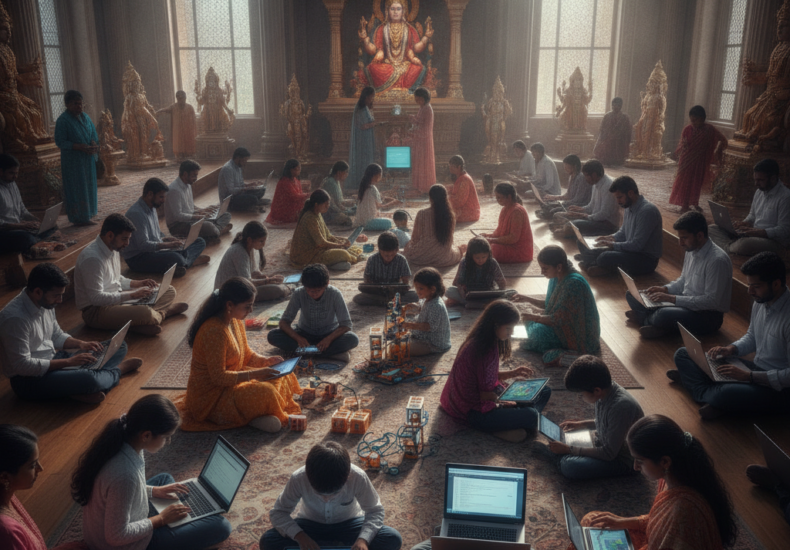
Tech Life as reflected on by Pandit Rajesh Sharma
Every weekend, our temple hall in Silicon Hills fills with families. Their weekdays are spent building the computational architectures that now reshape our world. After aarti, parents frequently ask a quiet, anxious question. The BBC report raises this same concern: when machines write code, draft essays, and synthesize information in seconds, what should our children learn? For our community, technical mastery has been the primary vehicle for prosperity. This question, therefore, strikes at the core of parental duty and future security. These are crucial **Tech Life Reflections** for our times.
Vedic Wisdom for Tech Life
From the Vedic tradition, this dilemma offers necessary clarification, not despair. Our ancient texts distinguish two kinds of learning. Apara vidya is worldly knowledge, technical skills, and empirical sciences. Para vidya, however, represents the foundational realization of one’s consciousness and ethical truth. In our modern rush, we often mistook technical proficiency for complete education. Now, artificial intelligence performs routine algorithmic tasks effortlessly. We are gently forced to remember a vital lesson: training an intellect without cultivating character produces a competent instrument without a guiding soul.
Our children do not merely need to acquire more specialized coding languages. Instead, they need to cultivate viveka, the capacity for clear moral discernment. Viveka is the inner faculty that cuts through illusion. It distinguishes between what is pleasant in the immediate moment and what is truly good and lasting. Algorithmic systems curate information, optimize attention, and generate persuasive falsehoods. A young person lacking viveka will simply become an unwitting consumer of synthetic thought. Discernment cannot be automated or outsourced to an algorithm because it requires an awake conscience rooted in ethical consequence.
Cultivating Character and Consciousness
Equally urgent is the teaching of dharma. Dharma defines our duty toward the harmony of the whole. If we teach children only how to leverage intelligence for market advantage, we train them in ambition detached from responsibility. A genuine education grounded in dharma instructs a young mind to ask important questions. It asks not just what a technology can build, but who it serves. It also asks what natural systems it disrupts, and whether it protects the dignity of living beings. In a digital environment dominated by speed and novelty, dharma provides an unshakeable compass. It honors restraint, justice, and the sacredness of human labor.
To support this inner strength, we must also reintroduce the discipline of dhyana, or sustained contemplative attention. The greatest vulnerability facing children today is not an absence of facts. Rather, it is the systematic fragmentation of their focus. Automated feeds dictate every pause and curiosity. Consequently, children lose the patience required for deep contemplation, creative synthesis, and genuine stillness. Sitting quietly with breath, chanting sacred verses, or simply walking among trees without a screen trains the mind. This practice helps the mind remain centered amidst sensory turbulence. A mind that cannot govern its own attention can never be truly free.
Finally, we must remind our young people that human value does not stem from computational efficiency. In Vedanta philosophy, every child embodies the Atman, an inherent spark of the divine. Each child possesses an innate capacity for compassion, selfless service, and awe. A machine can calculate probabilities and predict outcomes. However, it cannot experience the selfless dedication of seva. It also cannot grieve with a neighbor or feel wonder before the morning sun. If we anchor our children in these timeless truths, artificial intelligence will remain simply a tool in their hands. Meanwhile, their hearts will remain steadfast in the eternal light of wisdom. This is the essence of true **Tech Life Reflections**.

Leave a Reply